

The Science Behind Jeremiah 31
Where we view science in light of Scripture, and God’s promise to write His love on our hearts.

This isn’t a light read.
There’s a lot of science baked into this one, so do yourself a favor and read it slow. Sit with it. Let it unfold. I really do think it’ll make things shine.
I couldn’t not write this. When my wife told me about it, my face literally lit up—she looked at me like, “What the heck is wrong with you?” I was motivated at my core. It gave me a beautiful added perspective as a believer—one that made Jeremiah 31 feel even more real, even more grounded in how God designed us.
And I intentionally loaded this post with references so you can double-check my logic. Don’t take my word for it—verify it.
When my wife told me about a Wellness Mama episode with Dr. Bradley Nelson—talking about “heart walls,” trauma association, and the idea that emotional pain can get “stuck”—the light came on and I had to share.[1]
Let me be crystal-clear (so nobody can accuse me of being sloppy):
I’m not presenting Dr. Nelson’s model as mainstream cardiology. It’s a wellness framework, and you should treat it like that.
What I am doing is using that spark to pull together peer-reviewed scientific research on the heart–brain system, trauma physiology, interoception, and regulation—then reading Jeremiah 31 with that perspective.
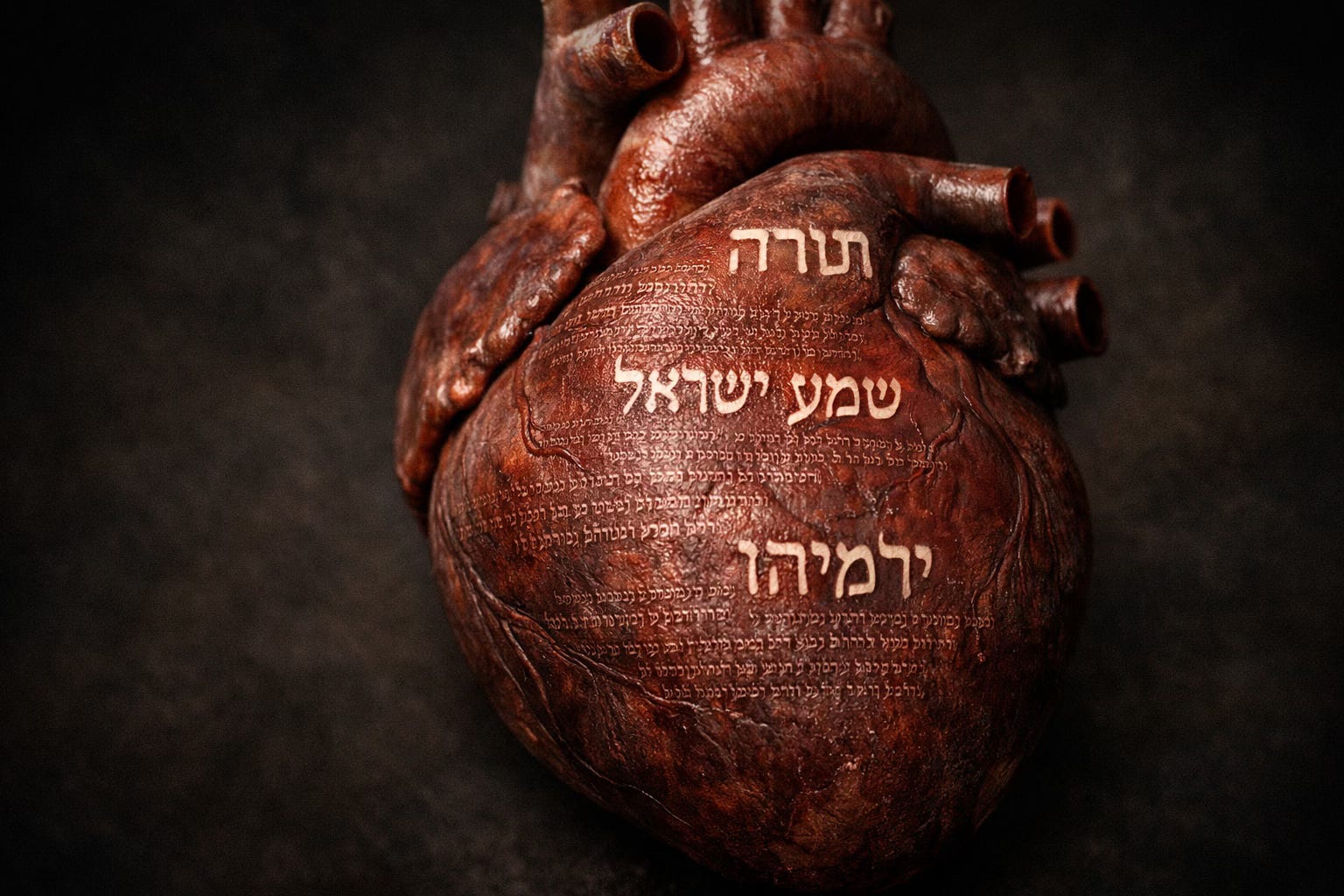
Because once you see what the heart is biologically connected to, Jeremiah’s language stops sounding like religious poetry and starts sounding like covenant reality: God can write on the deepest parts of a human being—not only “law,” not only “information,” but healing, transformation, renewal, and restoration.
Your heart isn’t only a pump. It’s beautifully wired.
Modern physiology is blunt about this: the heart has an embedded neural network called the intrinsic cardiac nervous system (ICNS).
One major review describes this first “in-the-heart” level of autonomic control as a true neuronal network—organized in ganglionated plexi within epicardial fat pads—and it contains not only efferent neurons but also afferent neurons and local circuit neurons.[2]
And the anatomy isn’t trivial.
A classic whole-heart analysis reported epicardiac ganglia counts ranging from 706 to 1,560, averaging 836 ± 76.[3]
No—this doesn’t mean “your heart thinks like your brain.”
Yes—it does mean your heart is part of a layered control system… and “heart” language in Scripture is pointing at something real: the place where inner patterns live.
Trauma doesn’t only live in your mind. It can live in your regulation.
One of the cleanest biomarkers used in trauma research is heart rate variability (HRV)—the beat-to-beat variation in time between heartbeats.
A meta-analysis in Psychological Medicine summarizes a key theme in the PTSD literature: PTSD is associated with lower HRV, consistent with altered autonomic functioning.[4]
That matters because it supports a hard truth:
Some “memory” isn’t a story you can tell.
It’s a pattern your nervous system runs.
So when Jeremiah 31 talks about something being written “on the heart,” I’m not hearing surface-level inspiration. I’m hearing a promise aimed right at the deepest layer of the human being—where patterns get stored and expressed.
HRV isn’t just “stress.” It tracks regulation capacity.
This is where it gets honestly wild!
A systematic review and meta-analysis examined vagally mediated HRV and executive functioning—your brain’s top-down regulation system (inhibition, working memory, flexibility). It’s not hype. It’s a careful synthesis of the evidence, and it still finds a meaningful association.[5]
A separate systematic review focused on HRV and decision-making—and while it’s careful about complexity, it still treats HRV as tied to cognitive function and worth serious evaluation.[6]
Then there’s social perception.
A Scientific Reports paper tied resting HF-HRV to “mind-reading” performance (Reading the Mind in the Eyes Test), showing measurable links between vagal regulation and social-cognitive sensitivity.[7]
And on the “why,” Mather & Thayer propose a mechanism: heart-rate oscillations may help strengthen functional connectivity in emotion-regulation brain networks.[8]
So here’s the takeaway I can’t unsee:
Your heart rhythm isn’t just a health metric.
It’s tangled up with how well you can regulate, perceive, and respond.
Now… read Jeremiah 31 with that echo in your head.
Interoception: your heartbeat can shape what becomes salient to you!
Interoception is your ability to sense internal signals—heartbeat included.
Garfinkel and colleagues distinguish accuracy, sensibility, and awareness as separate dimensions (and show they don’t always match).[9]
Then come the cardiac-cycle studies. They are not fluff.
A Journal of Neuroscience paper tested emotional processing at cardiac systole vs diastole and found fear processing is selectively gated by heartbeat timing—when baroreceptor signals are active.[10]
A Psychophysiology paper used continuous flash suppression to test whether emotional stimuli “break through” to awareness differently depending on cardiac phase—probing whether cardiac signals influence what reaches consciousness.[11]
And it doesn’t stop at perception. It touches self-control.
A Biological Psychology study found response inhibition was disrupted when action-relevant signals were aligned with cardiac systole—suggesting cardiac timing can influence inhibitory control.[12]
Put mildly:
Your inner signals don’t only react to your mind.
Sometimes they help shape what you notice… and what you do next.
And Jeremiah 31 is literally God saying: I’m going to write something into the center—into the heart—into the place where what you notice and what you do gets formed.
We are built to be shaped in relationship
Here’s another piece that matters for Jeremiah 31’s covenant frame:
Human beings can synchronize physiologically in close relationship.
A study in Infant Behavior and Development reported that mother and infant coordinate heart rhythms within lags of less than one second, and concordance increases during episodes of affect and vocal synchrony.[13]
I’m not using that to make mystical claims.
I’m saying the obvious: people co-regulate. People wound each other. People heal each other. And God restores people inside covenant life—not just in private thoughts.
Jeremiah 31 isn’t merely “personal spirituality.” It’s covenant restoration—hearts restored inside a people who know Him.
Now read Jeremiah 31 with a new perspective!
Jeremiah 31 opens with generational consequence—what one generation “eats” can leave another generation’s teeth set on edge.
That proverb exists because it’s real. Patterns get passed down.
Then God says something breathtaking: a New Covenant is coming. Not like the former one. Not merely external commands. Something internal.
Tree of Life language is direct: God will put His Torah within and write it on the heart.
And now—with the science in view—here’s what hits me personally:
The nervous system can carry patterns of fear, hypervigilance, shutdown, impulsivity, numbness. We call it trauma. We call it coping. We call it “just who I am.” But a lot of it is regulation patterns.[4]
The heart is wired into regulation—intrinsic neural networks, internal sensing, and heartbeat-timed effects on emotion processing and inhibition.[2–3, 9–12]
In other words, human beings are designed in a way where the inner person can be written on—for good or for harm.
So when God says He will write on the heart, I’m not hearing “God will make me more religious.”
I’m hearing: God can rewrite the inner operating system.
Not just “law,” but love.
Not just instruction, but wholeness.
Not just rules, but restoration.
That’s the amazing glow that I felt!
A quick word on free will (because yes… this connects)
All this science doesn’t erase free will. It actually explains why free will can feel weak, inconsistent, or “hijacked” in the moment.
Because your will doesn’t float in space. It runs through a body.
Free will is real… but it can be constrained
When your nervous system is regulated, you have a wider menu of choices. You can pause. You can weigh outcomes. You can respond instead of react. That’s the kind of territory HRV research keeps circling—linking regulation capacity to executive function and decision processes.[5][6]
But when your system is dysregulated—trauma, chronic stress, hypervigilance, shutdown—your “choice menu” shrinks fast. You slide into defaults: fight, flee, freeze, appease, control, numb, avoid. That doesn’t mean you didn’t choose. It means the system is shouting “threat,” and your calm options narrow.[4]
That’s why people can “know better” and still do worse.
The heart-body system shapes what even gets presented to your will
Interoception research gets blunt here: bodily signals can shape what becomes salient—what feels urgent, what grabs attention, what breaks through.[9][10][11]
And inhibition research adds another layer: internal timing signals can influence your ability to stop, hold back, and choose restraint.[12]
So free will doesn’t disappear. But the battlefield isn’t only thoughts. It’s physiology, urgency, impulse, and attention.
Jeremiah 31 reads like God restoring the will at the source
This is where the covenant promise becomes unbelievably hopeful.
Jeremiah 31 isn’t just God saying, “You’ll finally know the rules.”
It’s God saying, “I’m going to rewrite what’s going on inside you—at the level where your wants, your instincts, your loyalties, and your defaults live.”
That’s what Scripture calls “the heart.”
So from a free-will angle, Jeremiah 31 isn’t the canceling of choice. It’s the healing of choice.
Not just the power to choose…
but the ability to want what’s right, recognize what’s right under pressure, and choose it more consistently.
That’s actual freedom.
Obedience becomes the training ground of freedom
This is why I keep saying obedience isn’t cold.
Obedience is alignment. Obedience is cooperation with the rewrite.
If regulation capacity affects decision capacity, then practicing obedience—especially when it costs you—becomes part of how God retrains the inner person. Over time, the menu expands. The pause gets longer. The impulse gets weaker. The clarity gets stronger.
Science helps us understand the constraints on choice.
Jeremiah 31 is God addressing those constraints by renewing the heart.
That’s not religion. That’s restoration.
I’ll leave you with this
If the heart is tied into regulation…
and if regulation shapes perception…
and if perception shapes action…
…then the deepest kind of healing isn’t just “feeling better.” It’s being remade at the center.
Jeremiah 31 isn’t a slogan. It’s a promise that God can do what we cannot:
He can heal what trauma wrote.
He can renew what sin distorted.
He can restore what generations broke.
He can transform what we’ve learned to call “just who I am.”
And that’s why obedience isn’t a cold concept to me.
Obedience is alignment.
Obedience is what happens when the heart stops resisting and starts trusting.
Not because HRV saves you.
Not because science saves you.
Because the God who designed the system is the One who can rewrite it.
And that’s exactly what Jeremiah 31 says He intends to do.
May the shalom of our Abba guard you —
shalom v’shalvah.
Your brother in the Way,
Sergio.
It seems that the deeper you study science, the more it reveals God's fingerprints within the framework of creation.
It gets even more astounding when you consider that the primary function of the heart is to pump blood and circulate oxygen to the whole body. A crucial component of the red blood cell is iron, as it is the core component of the hemoglobin that binds to the oxygen.
Iron has an atomic number of 26, which corresponds to the gematric number of the Tetragrammaton, i.e. the name of God.
Oxygen has an atomic number of 8, which in Biblical numerology often symbolize new birth, new beginning, or resurrection. The name of Jesus, as rendered in the Greek NT manuscript (ΙΗΣΟΥΣ), adds up to 888 in the Greek isopsephy.
Furthermore, iron, particularly the isotope Fe-56, is one of the most stable element in the universe, and the most abundant. It marks the end point of stellar fusion (after which the element is too stable to undergo further fusion without losing net energy), and is the main component of the Earth's planetary core. It has a binding energy per nucleotide of around ~8.8 MeV.
I wrote an article on this few months ago: https://evangel108.substack.com/p/the-divine-fingerprints
It really puts Psalm 19 into perspective.
Love this...
"He can heal what trauma wrote.
He can renew what sin distorted.
He can restore what generations broke.
He can transform what we’ve learned to call “just who I am.”
And that’s why obedience isn’t a cold concept to me.
Obedience is alignment.
Obedience is what happens when the heart stops resisting and starts trusting."
I'll cap it with Nahum 1:7..(as opposed to Matthew 7:23) 'The Lord knows those who trust Him'..