

Unpacking #4: “Not So Among You”: The Church Ladder Jesus Condemned
If your “church order” requires a ladder, it’s already drifting from the Kingdom.

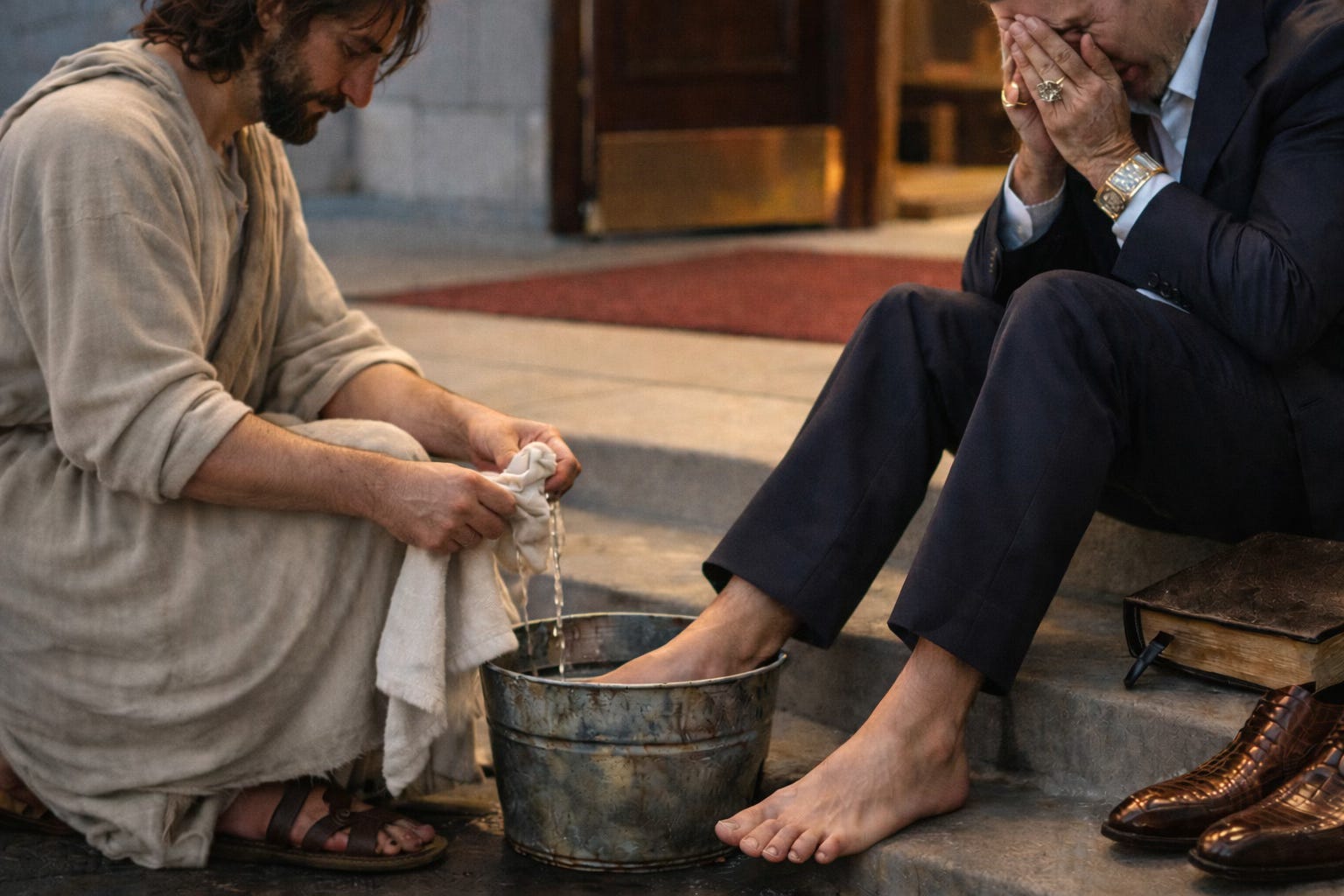
You can tell a lot about a religion by what it refuses to question.
In modern church life, there’s one thing that’s basically untouchable: the ladder. The hierarchy. The “covering.” The titles. The platform. The idea that one man stands closer to God than the rest of the room… and everyone else is safest when they stay quiet, stay loyal, and keep the institution running.
But here’s the problem. One of the clearest things Yeshua ever said about leadership is the exact opposite of what we’ve normalized:
“You know how the rulers of the nations lord it over them… not so among you.” (Mark 10:42–45)
That line isn’t a leadership tip. It’s a boundary line. Messiah drawing a circle and saying: If you import the world’s power structure into My people, you are not building My kingdom.
So yes—this is Unpacking #4. And we’re going straight for the root. Because once you accept a religious ladder, you’ll accept almost anything from the man standing on top of it.
The counterintuitive Kingdom: leadership that goes downward
Modern thinking says leadership rises.
The Kingdom says leadership descends.
The nations treat leadership like status.
Yeshua treats leadership like burden-bearing.
That’s why His words land like a hammer: “not so among you.” He’s not saying, “Don’t be harsh.” He’s saying, “Don’t run My people on the world’s operating system.”
In the world, leaders separate from the people so they can rule the people.
In the Kingdom, leaders stay close to the people so they can serve the people.
It doesn’t feel “strong” at first. It feels like losing. Like being overlooked. Like giving away power. And that’s exactly why it’s the Kingdom… you can’t fake it long without real humility.
Shepherd vs lord: the word-picture we keep trying to modernize away
Scripture’s leadership picture isn’t “executive.” It’s shepherd.
A lord leads from above.
A shepherd leads from among.
A lord drives with force.
A shepherd guides with presence.
A lord protects his position.
A shepherd protects the flock… even at cost to himself.
A shepherd doesn’t “cover” sheep by demanding loyalty. He covers them by knowing them, staying near, and stepping into danger when it matters. That’s why Peter’s definition is so direct:
Shepherd willingly… not for gain… not domineering… but being examples. (1 Peter 5:1–3)
Not domineering isn’t optional. It’s the line in the sand.
The big picture: Israel was meant to be a living example… then Messiah showed the whole point
This isn’t just a church-structure debate. It’s covenant identity.
Israel was called to be a visible witness before the nations—wise, distinct, and holy: a “kingdom of priests” (Ex. 19:5–6), a people whose obedience would display God’s wisdom (Deut. 4:6–8), and a light to the nations (Isa. 42:6; 49:6). Not perfect, but set apart as an example.
Then Yeshua steps into Israel’s story and embodies what covenant faithfulness looks like when it’s lived cleanly from the heart. And His “leadership” didn’t come from office. It came from obedience.
He obeyed the Father without negotiating. He emptied Himself, took the posture of a servant, and walked the path all the way down… even to death. And because He went that low in faithfulness, God exalted Him. (That’s the Philippians 2 shape.) In other words: His authority didn’t rise from a title. It rose from obedience. And the obedience expressed itself as service.
That’s the pattern. Obedience to God produces love for neighbor. And leadership in the Kingdom is simply what that obedience looks like in public.
The ladder feels “holy”… until you compare it to Jesus
Jesus didn’t deny leadership. He forbade a specific kind of leadership.
The Gentile model is power-over.
The Kingdom model is service-under.
So the question isn’t whether churches have leaders. The question is what kind.
Because a lot of what gets called “biblical order” today looks like the thing Yeshua contrasted Himself against:
A stage that functions like a throne.
Titles that function like rank.
“Honor” that functions like insulation from correction.
“Unity” that functions like silence.
“Submission” that functions like control.
If that lands hard… good. Messiah didn’t soften it.
A necessary clarification
To be clear: this isn’t a blanket accusation against every pastor or every congregation. I’ve known sincere shepherds who love people quietly and serve faithfully. What I’m challenging is the structure that turns shepherding into rank—because once the ladder is protected, the sheep always pay.
Titles aren’t harmless when they create a class system
People get nervous here because they don’t want to sound disrespectful. I get it. But respect and status aren’t the same thing.
Yeshua warned His disciples about a religious culture obsessed with titles, recognition, and being seen… and He told them not to imitate it (Matthew 23:8–12). The issue isn’t vocabulary. The issue is what titles become inside a ladder system: rank.
And once rank exists, a predictable chain reaction follows:
The leader becomes “closer to God” than the people.
The people become dependents instead of disciples.
The leader becomes gatekeeper of truth.
Questioning becomes rebellion.
Correction becomes “division.”
Accountability becomes optional.
The institution becomes what’s protected… not the sheep.
That’s not every congregation, everywhere. But it’s a pattern ladder-systems reliably drift toward.
The early ekklesia wasn’t a weekly show… it was a covenant people
When people picture “church,” they often picture a service: stage, sermon, lights, staff, schedule.
But the early ekklesia looked far more like a living community than an event.
Believers gathered, ate together, shared life, and handled real needs (Acts 2:42–47). They were devoted to teaching, fellowship, breaking bread, and prayers… not because they were consuming a product, but because they were becoming a people.
And they weren’t trained to be silent spectators.
There were real discussions. Real discernment. Real reasoning from Scripture and testimony (Acts 15). Leadership existed, but the community wasn’t treated like an audience. That’s profoundly Hebraic: truth is tested in community, leaders serve the people, faith is lived together.
And it wasn’t always clean—disputes happened, sharp disagreements happened—but the pattern stayed community-centered and accountable.
A ladder thrives where people are anonymous.
A covenant community thrives where people are known.
Plural leadership: the New Testament quietly refuses the “one-man king” model
Hierarchy usually needs a single elevated figure.
The New Testament pattern leans toward plural, local, accountable leadership—elders appointed in cities and congregations, overseers serving among the people, recognized servants laboring in the body (see Acts 14:23; Titus 1:5; Philippians 1:1).
Plurality does something the ladder hates: it forces accountability. It prevents one personality from becoming “the church.” It keeps doctrine from becoming a private brand. It keeps correction possible.
And that’s the point: leaders are meant to be correctable. If they’re not, they’re not safe.
The New Testament model equips the saints… it doesn’t replace them
Paul says leaders exist to equip the saints for the work of ministry (Ephesians 4:11–16).
That means the saints do ministry. The body functions. People mature. The whole community grows into stability and discernment.
But when leadership becomes a ladder, it flips that.
In ladder-systems, the “professional holy man” does the ministry and the people watch. Spiritual growth becomes attendance. Obedience becomes “support the vision.” And quietly, believers forget how to read Scripture without a personality interpreting it for them.
That’s how you get people who can quote pastors… but can’t test doctrine.
What about the gift of “leadership”?
Let’s be clear: the New Testament recognizes leadership.
Some people are genuinely gifted to organize, initiate, protect, build, and guide. Paul even names “leading” as a grace-gift (Romans 12:8). But a gift is not a rank. And leadership in Scripture doesn’t mean “I’m above you.” It means “I carry responsibility for you.”
In Romans 12, “leading” sits in a simple list of service gifts… and it’s paired with diligence, not dominance. No aura. No celebrity. No special caste. Just faithful responsibility inside the body.
So the question isn’t “Is leadership real?” It is.
The question is whether leadership in your community looks like Messiah… or like the nations.
Leadership passages in context… so they can’t be weaponized
People quote leadership verses like trump cards. The verses are real. The misuse is real too.
Those who labor among you (1 Thessalonians 5:12–13)
Notice the descriptors: they labor… they are among you… they admonish. That’s hands-dirty shepherding within community, not executive control from above it.
Imitate their faith (Hebrews 13:7)
Before “obey,” the author says “remember” leaders whose lives can be observed… imitate their faith. That’s accessible, character-forward leadership—not untouchable office.
Obey and submit (Hebrews 13:17)
Yes, it’s Scripture. No, it isn’t a blank check. The same verse says leaders will “give an account.” The frame is accountable care—not domination. If a leader demands submission while rejecting accountability, he wants authority without responsibility. That isn’t biblical.
Qualifications over charisma (1 Timothy 3; Titus 1)
These lists are boring on purpose. Scripture refuses to root leadership in talent. The anchor is character… self-control, hospitality, sound teaching, integrity, being above reproach. A man who can’t govern himself has no biblical claim to govern others.
Wolves can arise from within (Acts 20:28–30)
Paul warns leaders that wolves can come from outside and from within leadership itself. That means the New Testament never trains believers to be passive. It trains them to be discerning… because leaders can fail.
What do we build instead?
Not chaos. Not disrespect. Not “everyone does what’s right in their own eyes.”
We build what Scripture actually describes:
Covenant community over religious corporation.
Shared responsibility over spiritual spectatorship.
Leaders who are known, accessible, and correctable.
Teaching that equips people to read Scripture themselves.
Generosity that reaches real needs, not just overhead.
A body that functions… not a crowd that attends.
And this is where it gets beautiful.
People would be shocked how alive their faith becomes when they stop funding a machine to “do ministry for them” and start doing what the New Testament assumes believers do.
Help a real widow directly. Feed a real homeless person and sit with them. Meet real needs quietly. Pray in a living room. Open Scripture at a kitchen table. Let iron sharpen iron without a stage managing the moment.
That’s not anti-church.
That’s church.
Closing: the challenge
If you believe Yeshua meant what He said—“not so among you”—then you don’t get to admire this and move on.
Here’s the challenge: name the ladder you’re protecting—and then prove it from Scripture.
Where have you confused “honor” with “untouchable”?
Where have you called silence “unity”?
Where have you surrendered your discernment because it felt safer to let someone else think for you?
Where have you defended a system you can’t actually demonstrate from the text… because leaving it would cost you comfort, reputation, or community?
Second challenge—harder: build one small piece of the early ekklesia again. This week.
Invite believers into your home. Open the Scriptures together. Eat. Pray. Talk. Reason. Confess. Encourage. Meet a real need. Put money into a person, not a machine. Practice covenant life in miniature.
Because the Kingdom doesn’t advance through platforms. It advances through obedient people living like Messiah is actually King.
So decide. Not emotionally—covenantally:
Are you submitted to Messiah… or to a hierarchy that calls itself Messiah’s representative?
And if the ladder you’re standing on eventually requires silence to survive… if it can’t tolerate questions, correction, or accountability… don’t write a comment about it.
Step off it.
May the shalom of our Abba guard you —
shalom v’shalvah.
Your brother in The Way,
Sergio.
“Covering”… that word has been so abused, it now makes me cringe. 😬 Love the challenges at the end. I think if we had more households doing those things, we’d see a real change in our faith practice and communities.
I think it took some time for them to get it, but I am pretty certain that today the Sons of Thunder would fully affirm what you wrote. Thank you for your writing and may God continue to bless you in it.