

Unpacking #6: Why Your Church Loves “Africa Missions” (and the $50 Ask)
If the people in the seats can’t see the receipts, they’re not “partners” — they’re customers.

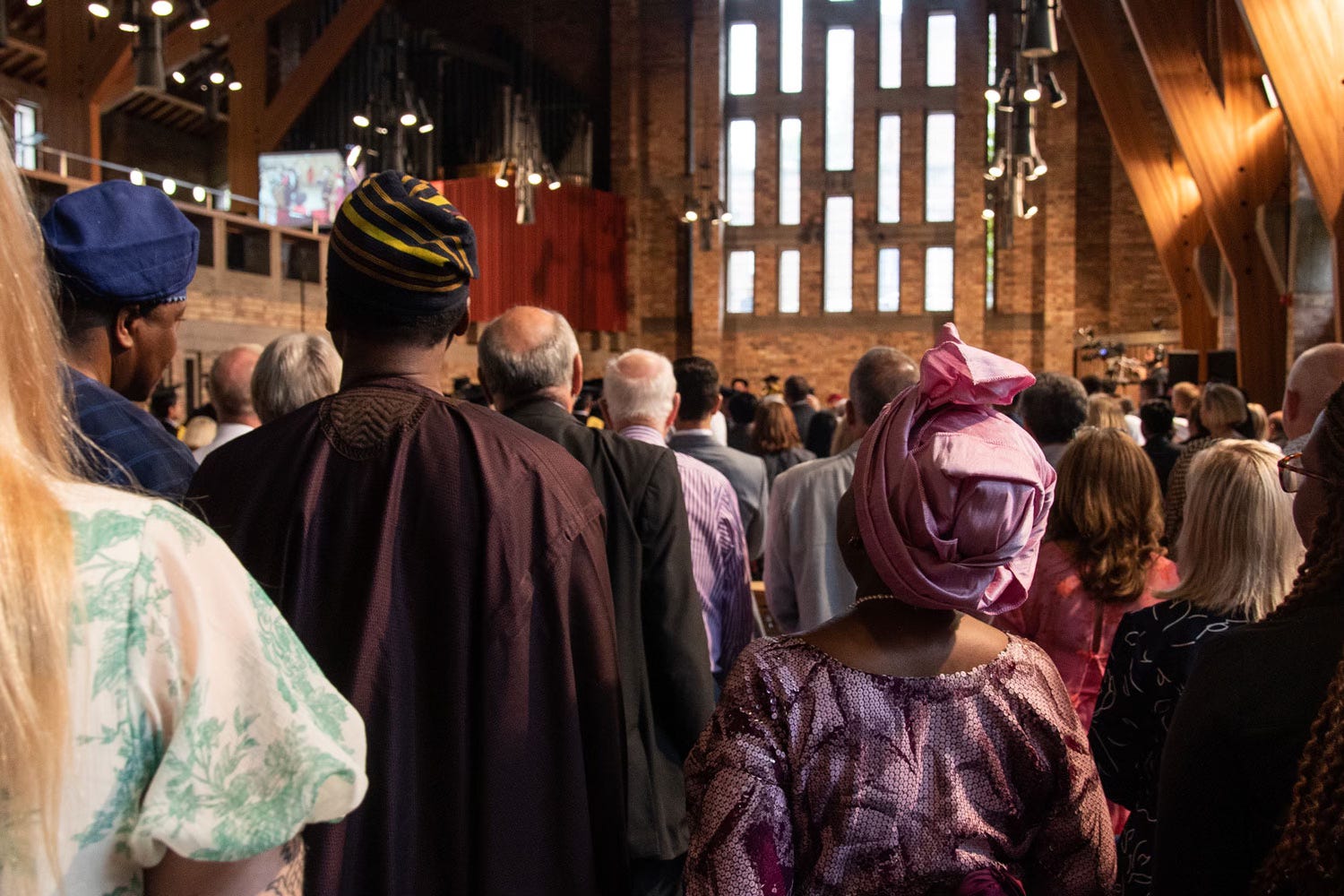
In the last two weeks, I got word of three different leaders in three different ministries—not connected, not in the same circles, not friends—all announcing big trips to Africa as a “mission journey.”
Then last night, I sat in a service at a church in Goodyear, Arizona.
A man went on stage and celebrated paying off $4 million on a building. Then the pivot came fast: we need money to go into new and unreached areas. And the pastor encouraged every person in the room to give $50 a head per month.
I did the math quietly.
If there are about 2,000 congregants, that ask is:
$100,000 per month
$1.2 million per year
That’s not “a little seed.” That’s a recurring revenue line.
And if even 20% of that base is carried by one industry—either because 20% of the room works in one sector or because one sector disproportionately funds the budget—you’re talking about roughly:
$20,000 per month
$240,000 per year
From one slice of the community.
So here’s the question I want regular people in pews to start asking:
When leaders make an emotional ask, what incentives are sitting behind it… and where is the money actually going?
Not where the stories say it’s going.
Where the money actually goes.
The part we miss: the visual and emotional machinery
Most giving campaigns aren’t built on spreadsheets. They’re built on imagery.
It’s the mission video.
The montage.
The shaky footage of a village road.
The close-up of a child’s face.
The swelling music under the pastor’s voice.
And none of that is inherently evil. But it’s not neutral either (Matthew 6:1–4).
Because the medium becomes its own argument:
Distance starts to feel like holiness. The farther away it is, the more “spiritual” it sounds. “Africa” carries a mystique that “our south-side apartment complex” doesn’t.
Aesthetic becomes evidence. If the video moved you, the work must be legitimate.
Emotion replaces accounting. You’re asked to feel first… and trust later.
The story becomes the product. Not outcomes. Not receipts. Not long-term local health. The story.
Here’s the gut-check:
Have you ever been to the poor parts of your own town?
Not driven through. Actually been there. Talked with people. Served. Learned names. Stayed long enough to be inconvenienced (Luke 10:25–37).
Because if you haven’t, the “Africa montage” can become a spiritual shortcut. It lets you feel like you touched poverty without touching anything that requires sustained local relationships and measurable responsibility.
And I’m going to press this with something personal.
There’s a woman in my small group who works here in the United States focusing on sex-trafficked children and abused minors. They are understaffed and under-resourced. Not in theory. In real life. Every week (James 1:27).
So I want to ask you plainly:
When was the last time your church put that kind of work on the big screen?
Not as a one-time “awareness” mention—but as an actual budget line with real staffing and sustained support (1 John 3:17–18).
Because this is where the optics start to reveal the incentives.
First, let’s be fair
There are real needs in Africa. There are faithful workers. There are regions with severe persecution and instability. There are places where aid matters and where believers are trying to survive.
This isn’t an “anti-Africa” article.
It’s a pro-truth article (2 Corinthians 8:20–21).
Because too many churches use “Africa” as a fog machine—and fog is very convenient when you’re moving money.
The uncomfortable reality nobody says out loud
A lot of “Africa missions” today is not first-contact gospel work.
Pew Research documented that the share of Christians in sub-Saharan Africa climbed from 9% (1910) to 63% (2010).[1] And Pew’s more recent analysis notes that between 2010 and 2020, sub-Saharan Africa surpassed Europe as the region with the largest Christian population.[2]
So when a U.S. church markets “Africa missions” as if Africa is a blank spiritual map… that’s already a problem.
Not because Africa is “finished.”
Because the sales pitch often doesn’t match reality (Proverbs 11:1).
The counterintuitive harm nobody talks about: this devalues African believers
Here’s the part that should bother us the most—and it’s not even about American money.
It’s about African dignity.
When churches constantly frame Africa as the needy receiver and America as the spiritual sender, it quietly teaches everyone in the room (including Africans) a false story:
Africans are always the “mission field,” never the church.
African pastors are always “in training,” never teachers.
African Christians are always “behind,” never fruitful.
African ministry is always “what we helped build,” never what God raised up among them.
This is not just a feelings issue. Missiology literature has warned for a long time that cross-cultural mission can slide into paternalism, and paternalism can produce dependency in indigenous churches.[8]
And the devaluing becomes very practical:
It creates a perceived reliance on the American church system
Even when African churches are thriving, the repeated narrative becomes: “they need us.” Over time, that reshapes expectations:
Local giving gets crowded out because “the Americans will cover it.”
Local leadership gets weakened because money often comes with methods, preferences, and control.
Local ministry becomes performative because stories, pictures, and deliverables are often aimed back toward donors, not toward local spiritual health.
It rewards the wrong incentives on the ground
If Western funding becomes the pathway to “success,” it can quietly pressure leaders to learn “donor language” more than they learn shepherding (1 Peter 5:2–3). That doesn’t mean Africans are dishonest. It means any system produces what it rewards—everywhere on earth.
It turns real African victories into American bragging rights
If Africa’s Christian growth and church vitality are real—and they are—then we should be careful not to rewrite African testimony as American achievement.
A church that constantly markets Africa as “our project” is not honoring African believers.
It’s branding them.
And the most “spiritual” form of disrespect is the one you can’t recognize because it wears a worship soundtrack.
“Unreached” is a real category — and it’s not the same thing as “Africa”
If a church says “unreached,” it should mean something.
You don’t need to memorize every number. You need to hold onto one basic thought:
“Unreached” is not a vibe. It’s a measurable category.
Joshua Project publicly tracks unreached people groups and provides current totals.[6]
So if a church is going to use the word, they should also be willing to answer:
Which people group?
Which language?
Which region?
Which long-term workers?
What’s the plan after the Americans fly home? (Luke 14:28)
If they can’t answer that, “unreached” is being used like a spell… not a strategy.
Here’s the real topic: the money and the missing missions P&L
Most church attenders never see a true missions P&L.
They see:
a pie chart
a stage announcement
a video clip
a few photos on the wall
and a “$50 ask” framed as obedience
What they don’t see is the basic business question:
How much of “missions” is travel… and how much is actual in-country support or long-term work?
Because here’s what a real missions P&L would show (plain English):
Airfare, hotels, meals, vans, visas, vaccines, “team fees”
How much money stayed in the U.S. (administration, planning, media production)
How much money actually reached the field
Names of partner organizations and amounts
Short-term trip spending vs long-term worker support
Outcomes measured six months later (not just “we felt changed”)
And here’s the line churches rarely want to say on stage:
Travel is expensive—and travel photographs well.
Why the room never gets a missions P&L: disclosure is optional
Most nonprofits file a Form 990 that the public can review.
Churches are different. The IRS explains that churches (and some church-affiliated organizations) are excepted from filing annual information returns like Form 990.[4]
Translation for normal people:
A church can be tax-exempt while not being required to give the public the same standardized annual financial disclosure other nonprofits provide.
So if a church is transparent, it’s usually voluntary—it’s a leadership choice.
And when transparency is voluntary, optics tend to beat accountability.
This is why “missions” can become such a convenient spending category: it’s spiritually untouchable, emotionally powerful, and often financially opaque.
The tax angle: real, but often used as moral cover
Let’s keep this simple and accurate.
The IRS allows certain travel deductions — but only under strict conditions
The IRS says you can claim a charitable deduction for travel expenses necessarily incurred while away from home performing services for a qualified organization only if there is no significant element of personal pleasure, recreation, or vacation in the travel.[3]
And the IRS adds the part most people ignore: even if you “enjoy the trip,” the deduction depends on being “on duty in a genuine and substantial sense throughout the trip.” If you have only nominal duties—or for significant parts of the trip you don’t have any duties—the travel isn’t deductible.[3]
So yes—tax benefits are real.
But tax benefits are not holiness.
And tax deductions are not proof of wise stewardship.
Also worth saying out loud: the IRS explicitly notes that contributions “to a specific individual” aren’t deductible, and it gives an example where paying a child’s missionary expenses doesn’t qualify as a deduction for the parent.[3]
Cross-border money moves = less visibility for the donor
This doesn’t mean every church is hiding something.
It means the structure naturally reduces visibility.
FinCEN’s own FBAR guidance states that a U.S. person with a financial interest in or signature authority over foreign financial accounts must file an FBAR if the aggregate value exceeds $10,000 at any time during the calendar year.[5]
The point isn’t “FBAR = scandal.”
The point is: international complexity grows faster than local accountability.
So if a church wants the congregation funding international work, the church should proactively increase transparency… not decrease it (Luke 16:10–12).
The incentive structure nobody wants named
I’m not claiming every pastor is corrupt.
I’m saying the system rewards certain behaviors.
Why pastors and leaders like international missions trips
It builds credibility: “I just got back from Africa…”
It produces sermon content and emotional stories
It creates status without having to solve hard local problems
It’s easier to fundraise around a distant need narrative than a complicated neighbor
Why churches like them
High optics, low scrutiny
Overseas partners don’t show up at board meetings
Outcomes can stay abstract: “lives were changed” instead of “here’s the ledger”
Why mission organizations like them
Short-term teams can function like a revenue stream
Recurring donors become stable monthly income
Auditing outcomes across language, culture, and jurisdiction is hard and expensive
So yes… there’s incentive behind the ask.
Not “evil.”
Incentive.
And incentives don’t care how sincere you are.
A hard but necessary data point
One reason I’m pressing on this is because the Christian world has a real internal financial integrity problem.
The Center for the Study of Global Christianity publishes “Status of Global Christianity” tables. In their 2024 table, “ecclesiastical crime” is listed as $67 billion (2023) and $86 billion (2024)—and the table itself explains these are model-based estimates derived from their methodology and sources.[7]
These are estimates, not audited totals.
But even as estimates, they make one point unavoidable:
If internal controls are weak, sending money into low-visibility channels is exactly where waste thrives.
So the answer to that isn’t “stop asking questions.”
The answer is: tighten stewardship until it’s clean (Proverbs 27:23–24).
The “$50 ask” isn’t small. It’s scalable.
When a leader says “just $50 a month,” it feels like a personal devotion moment.
But at scale, it becomes:
predictable recurring revenue
with enormous flexibility
under low public disclosure pressure
fueled by emotion and moral framing
That’s why it works.
And that’s why it’s dangerous.
Because if the church can’t tell you where the dollars go, then “missions” becomes a branding tool… not a sacred trust.
What Scripture actually pushes us toward
God is not allergic to questions. He’s allergic to crooked scales (Proverbs 11:1).
We are told to do what is honorable “not only in the Lord’s sight but also in the sight of man” (2 Corinthians 8:20–21).
We’re warned about leaders who “lord it over” the flock (1 Peter 5:2–3).
We’re commanded to care for the vulnerable in a real, tangible way (James 1:27).
We’re told love isn’t words—it’s provision and truth in action (1 John 3:17–18).
We’re warned that “religious” acts can be performed for public approval (Matthew 6:1–4).
And when money was being mishandled in the early community, the apostles didn’t call transparency “rebellion”—they structured accountability so trust wouldn’t be weaponized (Acts 6:1–4).
So no—asking for receipts isn’t rebellion.
It’s basic biblical integrity.
What you should ask your church for (and why this is not rebellion)
If your church wants you to fund “unreached areas,” ask for a simple, one-page Missions P&L that answers:
Total missions spending last fiscal year: $_____
Short-term trips (all-in): $_____
Long-term workers supported: $_____
Direct in-country support to partners: $_____
Admin/processing/media/fees: $_____
Names of partner orgs + amounts given: list
Measurable outcomes tracked 6–12 months later: summary
And for each short-term trip:
Total trip cost
Number of participants
Percent spent on travel/logistics vs local partners
What work continued after the team left
Who is accountable on the ground
And while you’re at it, ask one more question that cuts through the fog:
“How much do we spend annually on the vulnerable within 15 minutes of this building?”
Because if a church can fund passport stamps but can’t staff local mercy… something is off.
The mirror
If your church needs $50 a month from every head in the room…
It is not sinful to ask:
Are we funding ministry… or funding an institution’s appetite?
Because “unreached” can be real… and still be used as a sales pitch.
And “missions” can be holy… and still become a machine.
And here’s the deeper mirror: if our missions story requires Africans to stay “needy” in the American imagination, then what we’re funding isn’t partnership. It’s a narrative.
Where I land
Give. Be generous. Support faithful work.
But don’t hand your conscience to a stage microphone (1 Thessalonians 5:21).
If a church asks for millions, it should offer clarity that matches the ask.
Because when the people in the seats can’t see the receipts, they’re not partners.
They’re customers.

A closing challenge to the matrix
Here’s what I think is happening beneath all of this—something most believers feel but don’t want to name.
Modern Christianity has built a machine.
A system that measures “health” by attendance, buildings, production value, and constant expansion. A system that needs a steady stream of fresh vision to keep the giving emotional. A system that loves causes that look heroic from a stage and can’t be audited by the people writing the checks.
And the most dangerous part?
The machine can run on “Jesus language” while quietly training the sheep to confuse:
tears with truth,
montage with mission,
travel with sacrifice,
platform with authority,
and giving with obedience—even when the stewardship is murky.
So I’ll ask you the way I’d ask myself:
If your church can’t show you a missions P&L…
If they can’t tell you what percentage went to travel vs actual ministry…
If “unreached” is a slogan instead of a strategy…
If the poor in your own zip code remain invisible…
If a woman fighting for trafficked children can’t get staffing while the stage can fund flights…
Then maybe the question isn’t, “Why aren’t you giving?”
Maybe the question is:
What exactly are you being asked to fund?
Because the Kingdom doesn’t need a fog machine.
It needs light.
May the shalom of our Abba guard you —
shalom v’shalvah.
Your brother in the Way,
Sergio
Thanks Mr DeSoto
I live in Africa and can confirm that the church in Africa is probably strong enough to handle continental missions. That said, the foreign missionary is usually wondered at and finds access quite comfortably.
I would say, go to the Sahel, go to Sudan, to Comores. Sub-saharan is sorted. In South Africa we find that the nations of Africa are being sent to us and we minister to them here, where they are in the minority (especially Muslims).
I also go Missionairing and find your article on point and very practical.
Thanks for great work, always.
A brother in the Way.
I wonder with people who go on worldwide mission trips if they have shared the gospel with their family and communities yet. That is free.
I also wonder what message are these people spreading? That part is never mentioned, and it isn’t obvious