

When Jesus Walked in Winter
How a “Non-Biblical” Jewish Feast Exposes Our Compromises and Calls Us Back to Covenant Loyalty

Winter in Jerusalem and a “Non-Biblical” Feast
John is not casual with details.
“At that time the Feast of Dedication took place at Jerusalem. It was winter,
and Jesus was walking in the temple, in the colonnade of Solomon.” (John 10:22–23)
It’s winter. It’s Jerusalem. Yeshua is walking the Temple courts. And John stops to tell you which feast it is: the Feast of Dedication—Hanukkah.
Not Passover. Not Shavuot. Not Sukkot.
And not one of the Leviticus 23 moedim.
Most Christians blow past that line as scenery. We rush into “My sheep hear My voice” and “no one can snatch them out of My hand,” as if those words dropped in a vacuum instead of in the middle of a very particular feast with a very particular history.
But John is anchoring Yeshua’s claims in a story:
a defiled Temple, a corrupt empire, a compromised priesthood, and a remnant who chose death over compromise.
If you don’t know that story, you will misread what it means for Yeshua to walk those courts in winter and say, “I and the Father are one.”
This isn’t just about Jewish history. It’s about your loyalties.
What You Were (Probably) Never Told About Hanukkah and John 10
Here’s how John 10 usually lands in church:
“Jesus is the Good Shepherd.”
“You’re safe in His hand—eternal security.”
“Those Jews just wouldn’t believe—don’t be like them.”
Maybe someone mentions that this happens “around some Jewish festival,” but the feast itself is treated like throwaway flavor.
Hanukkah, if it’s mentioned at all, gets reduced to something like:
“Our Jewish friends celebrate Hanukkah, the Festival of Lights.”
“There’s a story about a jar of oil that miraculously lasted eight days.”
“Isn’t that sweet? God does miracles.”
No outlawed Torah.
No circumcision bans.
No swine on the altar.
No common priest who says “no” to an imperial decree.
No blood. No revolt. No rededication.
So we end up carrying a set of lazy assumptions:
Hanukkah is “just a Jewish holiday” with no real weight for believers in Yeshua.
John mentioning the Feast of Dedication is random color, not theology.
The Hanukkah story is mainly about a jar of oil.
Anything outside Leviticus 23 is spiritually optional and basically irrelevant.
If that’s the framework, John 10 becomes a generic doctrinal paragraph and Hanukkah becomes a children’s story.
The reality is far more costly—and far more uncomfortable for us.
The Real Hanukkah Story: Empire, Apostasy, and a Village Priest
Hanukkah begins under a king named Antiochus IV Epiphanes, ruler of the Seleucid empire. He doesn’t just want land; he wants uniformity. One culture, one language, one set of gods.
Israel—with its stubborn insistence on one God, one Torah, one Temple—is a problem. So he does what empires do when they’re tired of dissent:
He outlaws Torah obedience.
He bans circumcision.
He forbids Sabbath observance.
He orders Jews to sacrifice to Greek gods and eat what God forbids.
Then he goes straight into the heart of Jewish worship—the Temple in Jerusalem—erects a pagan altar, sacrifices swine on God’s altar, and dedicates His house to Zeus.
That’s the starting point of Hanukkah:
not candles and songs, but a government that criminalizes obedience to the God of Israel and deliberately desecrates His dwelling.
Into that moment steps a nobody.
Not a king. Not a celebrity rabbi. A village priest in a town called Modi’in: Mattathias.
Royal officers set up a portable altar and tell him:
“You, priest—set the example. Offer the sacrifice. Show your people it’s safe to obey the king.”
They dangle rewards: honor, security, advantage.
Another Jew steps forward, ready to compromise, ready to save his own skin by obeying the decree.
Mattathias snaps.
He kills the compromising Jew. He kills the king’s agent. He tears down the pagan altar. And then he flees with his sons into the hills.
It’s not soft. It’s not polite. It’s not the sort of thing we put on a felt board in children’s church. But Heaven registers it as faithfulness.
From that one act—one priest refusing to lead God’s people into sin—a resistance movement forms. Mattathias’ sons, especially Judah (nicknamed “Maccabee”—the Hammer), organize a guerilla revolt. They are outnumbered and outgunned. They fight anyway.
They choose persecution over assimilation.
They choose caves and wilderness over comfortable compromise.
They choose obedience over safety.
After years of brutal war, the Maccabees recapture Jerusalem. They enter the Temple and see it ravaged—altars to idols, swine-stained stones, holy things profaned.
So they:
Tear down the desecrated altar.
Build a new altar.
Cleanse and reconsecrate the Temple.
Restore proper sacrifices and priestly service.
Hold an eight-day celebration modeled after Sukkot—because persecution had kept them from celebrating it on time.
That is Hanukkah:
Temple desecration → revolt → cleansing → rededication → an annual memorial that God preserved His worship in Israel.
What about the oil?
The famous “one cruse of oil that lasted eight days” comes from later rabbinic tradition. Could God have done it? Of course. But the original Maccabean histories don’t emphasize a cute miracle. They emphasize:
Persecution.
Forced assimilation.
Costly resistance.
Cleansing.
Rededication.
The oil story is comfortable and safe. The Maccabean story isn’t. It says:
A “nobody” can be the spark Heaven uses.
Government decrees do not overrule God’s commands.
Religious leaders who cooperate with ungodly edicts are part of the problem.
God sides with those who choose faithfulness over compliance, even when it makes them look extreme.
That’s the story John quietly invokes when he says, “It was the Feast of Dedication. It was winter. And Yeshua was walking in the Temple.”
John 8–10 Through Hanukkah Eyes: Light, Blindness, and a Rededicated Temple
Now read the surrounding chapters with that history sitting in your gut.
John structures his narrative intentionally:
In John 8, Yeshua stands in the Temple and declares, “I am the light of the world.”
In John 9, He heals a man born blind. Physical eyes open; spiritual eyes stay shut. The leaders insist they “see” while standing in darkness.
In John 10, He describes Himself as the Good Shepherd. His sheep hear His voice. Thieves and strangers climb in another way.
Then John drops the line:
“At that time the Feast of Dedication took place at Jerusalem. It was winter…”
That’s not a throwaway timestamp. It’s a theological stage direction.
Yeshua is walking in a Temple that exists because someone once chose covenant over compromise. The people around Him are celebrating that rededication.
And what do the leaders do?
“How long will you keep us in suspense? If you are the Christ, tell us plainly.” (John 10:24)
He tells them:
His works testify.
His sheep know His voice.
He gives eternal life; no one can snatch them from His hand.
“I and the Father are one.” (John 10:30)
Their response? They pick up stones to kill Him—inside the courts of a Temple that was saved because a priest refused to cooperate with a king.
Hanukkah is about rededicating God’s house.
Yeshua, the true Temple in human flesh, is standing in that house calling for a deeper dedication. The guardians of the institution try to destroy Him in the name of protecting the very God He is one with.
You can clean the building and still refuse to be cleansed yourself. That’s the indictment.
Light, Temple, and Identity: The Shadow and the Reality
Hanukkah is about light in darkness. Lamps in winter. The stubborn continued presence of God with His people.
John frames his Gospel around that theme:
Light of the world (John 8).
Eyes opened (John 9).
Shepherd in the Feast of Dedication (John 10).
Set against a festival of lights, Yeshua is saying:
“You’re celebrating that God kept His light burning in this Temple.
I am that Light. And I am the true Temple.”
The original stone Temple was:
The place where God chose to make His presence dwell.
The center of sacrifice and atonement.
The visible symbol of covenant with Israel.
Yeshua looks at that building and says in John 2:
“Destroy this temple, and in three days I will raise it up.”
John explains: He was talking about His body.
In other words:
The building is a shadow.
His body is the reality.
The Temple system is a living parable of Him.
So when He walks a rededicated Temple during Hanukkah and claims, “I and the Father are one,” He is essentially saying:
“You fought to reclaim this house for God.
Now God Himself is standing in front of you.
Will you rededicate yourselves?”
We like to say, “The Temple doesn’t matter anymore; we’re the temple now,” in a way that quietly lowers the bar.
But the God who demanded a cleansed house of stone has not become more relaxed now that His dwelling is flesh and blood.
Are We Commanded to Keep Hanukkah?
So what do we do with this? Are believers required to keep Hanukkah?
Torah is clear about God’s appointed times in Leviticus 23—Shabbat, Passover, Unleavened Bread, Firstfruits, Shavuot, Yom Teruah, Yom Kippur, Sukkot. Hanukkah isn’t listed.
We also see another kind of day in Scripture: Purim in the book of Esther—a memorial rooted in God’s deliverance, but not from Leviticus 23.
Hanukkah stands in that category:
Not a Torah-mandated feast.
Yet a deeply significant memorial in the history of God’s people.
John 10 shows Yeshua:
Present in Jerusalem during Hanukkah.
Teaching in the Temple.
Using this context to reveal who He is.
There is no hint of Him rebuking the feast or condemning those who keep it.
In the New Testament, Paul addresses disputes about days and practices and says:
Some esteem one day above another, some treat every day alike.
Each should be convinced in his own mind.
Whatever you do, do it unto the Lord.
So we can dump both ditches:
You are not more righteous or “in the know” just because you keep Hanukkah.
You are not safer or more faithful because you refuse anything “Jewish” that isn’t in Leviticus 23.
You are free.
You are free not to engage it.
You are also free to use it as a serious, Scripture-anchored reminder of:
Government overreach vs. God’s law.
Religious compromise vs. covenant loyalty.
Temple desecration vs. rededication.
Yeshua as the true Light and true Temple.
The real question is not, “Am I obligated?”
It’s, “Am I willing to let this story confront how I live?”
Government, Religion, and the Courage of a Nobody
Hanukkah puts a spotlight on something we’d rather not face: how easily we hide cowardice behind a misquoted “submission to authority.”
Antiochus did not ask Israel to stop “believing in God in their hearts.” He demanded public conformity:
Violate Torah.
Participate in idolatry.
Prove your loyalty by doing what God forbids.
The crisis was not “Do you love God inside?” The crisis was “Will you obey God when the state orders the opposite?”
Mattathias chose obedience to God over obedience to the king. Scripture consistently honors that kind of resistance:
Daniel and his friends refuse the king’s food and refuse to bow to an image.
Daniel keeps praying when prayer is outlawed.
The apostles say, “We must obey God rather than men,” when ordered to stop speaking in Yeshua’s name.
Hanukkah sits in that same line.
If your version of faith never puts you at odds with laws, policies, or cultural pressures that openly contradict God’s word, something is wrong. If “being a good Christian citizen” always lines up neatly with “never rock the boat,” you aren’t following the Maccabean pattern—you’re closer to the compliant priests.
Hanukkah is not political nostalgia. It’s a yearly question:
When power demands what God forbids,
will you bow, negotiate, or stand?
We Are the Temple Now: What Rededication Actually Looks Like
The New Testament doesn’t just say “you’re forgiven.” It says:
“Do you not know that your body is a temple of the Holy Spirit within you…
You are not your own, for you were bought with a price. So glorify God in your body.” (1 Cor 6:19–20)
The community of believers is called a spiritual house, a holy priesthood. God moved His address—from stone walls to living people.
That sounds beautiful until you remember how serious He was about His house being holy.
What does desecration look like now?
Sexual sin kept in the dark while we sing worship songs.
Greed and materialism baptized as “God’s blessing.”
Leaders using people as fuel for their platform.
Gossip and slander treated as harmless.
Abuse and manipulation being hidden “for the good of the ministry.”
Family, politics, or ministry itself quietly taking the place only God should have.
We’ve turned “your body is a temple” into a self-care slogan. Biblically, it is a holiness verdict.
If swine on the altar was desecration then, what does God call what we tolerate on the altars of our hearts now?
Hanukkah gives you a simple pattern of rededication:
Identify what has defiled the temple.
Not justify. Not redefine. Name it.
Remove it ruthlessly.
Don’t manage your idols. Tear them down.
Cleanse and restore what God intended.
Replace lies with truth, addiction with discipline, apathy with obedience.
Celebrate His faithfulness.
Not because you were strong, but because He did not abandon His temple.
That’s rededication. Anything less is religious interior decorating.
How a Disciple of Yeshua Can Engage Hanukkah Without Losing the Plot
Let me put this personally:
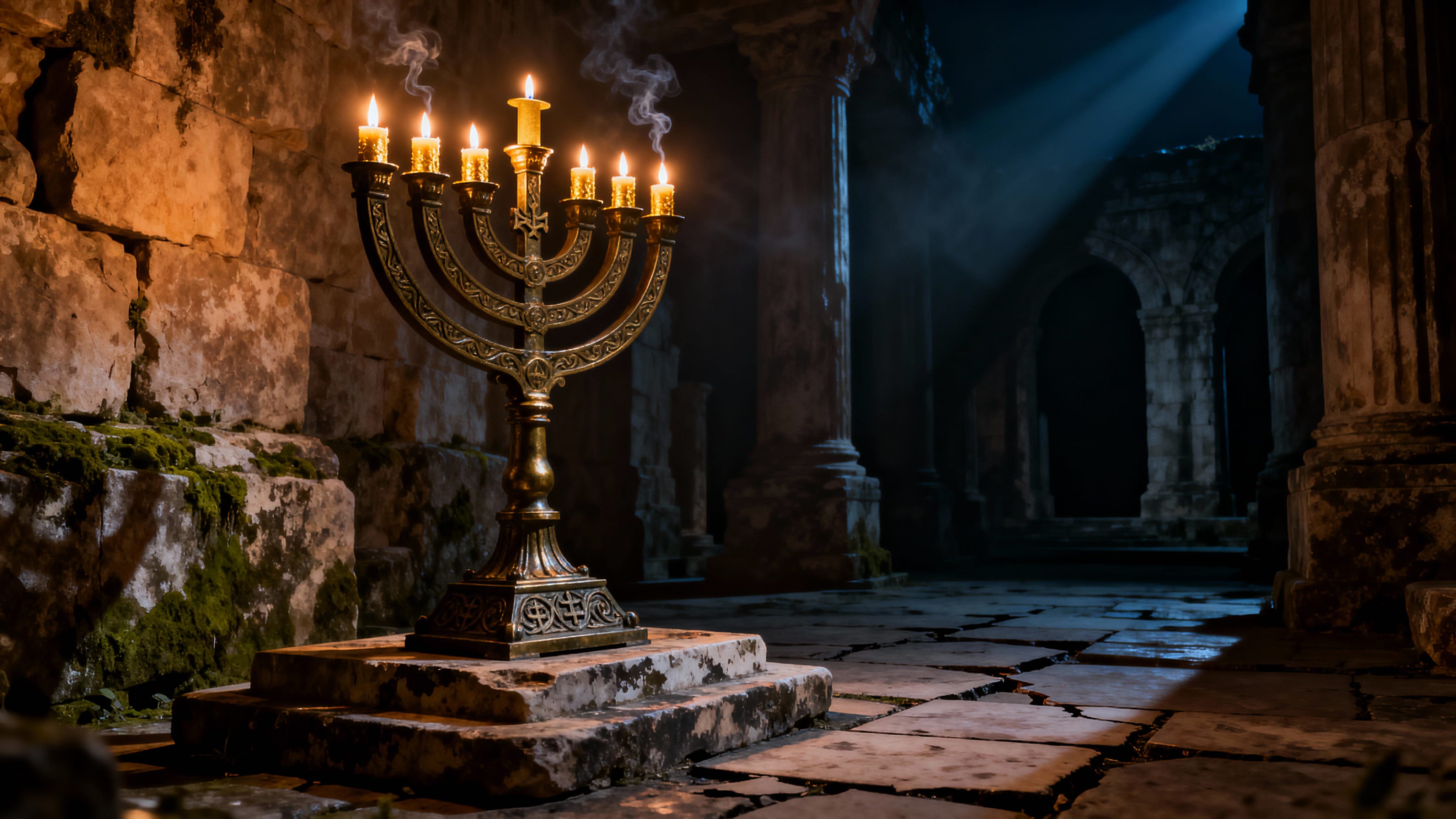
I celebrate Hanukkah every year. My menorah sits on a stand by my front window. I light it with love and with a pure heart—not as a performance, not to earn points, but as an act of remembering:
That God preserved His worship in Israel.
That He honors those who refuse to bow.
That my own life needs constant cleansing and rededication.
You don’t have to copy me. But if you engage Hanukkah, engage it as a disciple, not as a tourist.
Some simple, grounded ways:
Light a hanukkiah with intention.
As you light, tell the real story: the decrees, the pressure, the village priest, the revolt, the cleansing, the rededication.
Read passages like John 8–10, Daniel 3 and 6, parts of 1–2 Maccabees, 1 Corinthians 6.
Pray specific prayers of dedication.
Over your home: “Let this house be Yours, not Babylon’s.”
Over your body: “Let this be a living sacrifice, not a playground for sin.”
Over your marriage, children, congregation: “Guard us from compromise; make us faithful.”
Talk honestly about pressure.
Ask your family or community: Where are we already feeling the pull to soften truth or hide obedience? What lines will we not cross?
And watch the ditches:
Don’t LARP Judaism—turning Hanukkah into a costume to feel more “authentic” than other believers.
Don’t despise Jewish history—acting like anything that didn’t start in a Gentile church is automatically legalism.
Use the feast like a scalpel, not a trophy: a tool in the Spirit’s hand to cut away compromise and deepen loyalty to Yeshua.
Competing Winter Stories: Which One is Shaping You?
Winter in the West comes with its own liturgy—decorations, shopping, sentimental “holiday spirit,” and a thin spiritual layer: “It’s Jesus’ birthday.”
I’m not here to run a bonfire for Christmas trees. That’s not the point.
The point is that every season trains you to live inside a particular story.
One story says: peace means comfort, coziness, and everyone getting along as long as we don’t talk about anything costly.
Another story says: peace with God may put you at war with idols, and faithfulness may cost you comfort, approval, and safety.
Hanukkah’s root story is:
Defiance against assimilation.
Cleansing God’s dwelling.
Joy in rededication after warfare.
Much of what passes for “Christian holiday culture” is:
Cultural conformity with a thin Christian veneer.
Sentiment in place of sacrifice.
Noise instead of holiness.
You have to decide which story is forming you, your children, and your instincts:
When pressure comes, will your reflex be “keep the peace” or “keep the covenant”?
When the system tells you to bow “just this once,” what will your bones know how to do?
You don’t have to pick a side in some internet war about holidays to answer that. You just have to be honest about which narrative has your heart.
An Uncomfortable Invitation: Becoming Maccabean Disciples, Not Religious Consumers
Hanukkah is not cute. It’s an accusation and an invitation.
In that ancient crisis:
Empire said, “Bow.”
The religious establishment mostly complied.
A small remnant said, “No,” and bled for it.
We are not better than them. Our systems are not cleaner. We’ve simply learned to hide compromise under better language.
So here is the invitation, and it is not soft.
Read the real story.
Don’t just repeat the oil line. Sit with 1 and 2 Maccabees.
Feel the pressure to conform.
Watch the negotiations, the excuses, the fear.
Watch what it costs the ones who stand.
Then lay that next to your own reality:
Your news feed.
Your church culture.
Your workplace.
Your home.
Ask:
Where are today’s decrees—legal or cultural—demanding that I call evil good or good evil?
Where are leaders smoothing compromise in religious language?
Where am I being trained to keep my head down instead of open my mouth?
Be brutally honest about the system you’re in.
Every religious system has places you’re not allowed to touch:
Sins you’re not allowed to name.
People you’re not allowed to question.
Idols you’re not allowed to topple.
Find them.
If calling out abuse gets you branded “divisive,” that’s a line.
If preaching repentance threatens the brand, that’s a line.
If obeying Scripture would cost you your position or platform, that’s a line.
Hanukkah is God saying:
“When My house is at stake, I am not impressed by men who keep their salary and lose their soul.”
Be more Maccabean.
No, not in the sense of grabbing a sword.
In the sense of grabbing a spine.
Maccabean faith in Messiah looks like:
Saying “no” when your system blesses what God curses.
Walking away from roles and reputations that demand your silence.
Guarding the purity of God’s house—even if “house” is just your small living room gathering.
Accepting that obedience may cost you comfort, friends, opportunities, and applause.
You can stay a safe, compliant priest of a comfortable religion.
Or you can be a loyal disciple of the King who walked the Temple in winter and refused to bow to anyone but His Father.
You will not get both.
So don’t just light candles and feel warm this year.
Let the story interrogate you.
Let the Light of the world walk through your courts—your heart, your home, your congregation—and show you what’s defiled and what’s devoted.
Let Him make your life into a Hanukkah story:
a temple once compromised, now cleansed and wholly rededicated to the God of Israel and to His Messiah, Yeshua.
When the pressure comes—and it will—ask yourself:
Am I going to be a compliant priest of the system,
or a Maccabean disciple of the King?
May the shalom of our Abba guard you —
shalom v’shalvah.
Your brother in the Way,
Sergio.
© Sergio DeSoto / SD Blog Project. All rights reserved. This is original, protected work. Pastors and teachers: please do not lift or republish this content as your own. If you share or preach from it, simply credit the source and author. Integrity begins in the pulpit.
Hi Sergio! This is uncle Mike. I enjoy reading your posts. This post, however, was exceptionally good! Keep up the good work!!
Romans owned the corrupt priesthood and defiled the Temple in the 1st century and Jesus cleansed it as a protest against compromise with Romans. Then 300 years later his church was corrupted by the very same poison, owned and managed by the Emperor and turned into a political beast. We've struggled with that poison ever since.