

The Passover Has Been Hijacked
John 6 doesn’t teach “ritual mechanics”… it forces a covenant decision

Make sure you are in a place where you can think deep, perhaps with a coffee in hand… because John 6 isn’t confusing. It’s confrontational.
What became confusing over time is how easily people detach covenant language from covenant context. And once a passage is untethered from Torah categories, it becomes usable—malleable—something that can be turned into a religious product, a slogan, or a system.
So here’s what I’m going to do in this article—just me and you, going deep. I’ll keep it intriguing, but I’m not sacrificing any substance:
I’ll keep John 6 where John puts it… inside Passover
I’ll rebuild “eat my flesh / drink my blood” from Masoretic Hebrew + Levitical altar logic
I’ll expand the cannibalism issue until there’s no fog left: Yeshua is not endorsing cannibalistic behavior
I’ll keep the “communion got flattened” critique… but tighten it so it’s beyond reproach
I’ll keep the whole-book-of-John thread: Messiah healing a fractured house (Jews and Samaritans, insiders and outsiders, tribe and tribe)
To be honest… once you let Torah set the categories, John 6 stops being a sacrament battlefield and becomes what it actually is:
A Passover-shaped covenant test.
John is not writing a church manual… he’s writing a Jewish Gospel with a healing agenda
Yes, John is written in Greek. But it thinks in Jewish frames: feasts, Torah echoes, witness language, tabernacle/temple themes, covenant life.
And John’s burden is bigger than “how to get saved.”
John keeps pulling you toward a single question:
Who is going to become one family again… and where will that unity be found?
That’s why John 4 matters so much.
Messiah walks into the Jew/Samaritan boundary like it’s nothing… and exposes what the feud really is: rival holy places, rival identities, rival claims to “the real worship.” Then He relocates worship to Spirit and truth… and a Samaritan town confesses Him as “Savior of the world.”
That’s not filler. That’s John showing you that Messiah doesn’t just rescue individuals… He rebuilds a people.
And if you’ve read John 13–17 slowly, you already know where this is going: abiding, love, unity, “that they may be one.”
So when John 6 hits… don’t treat it like a stand-alone “communion chapter.” It’s part of John’s larger healing storyline.
John’s structure has a Jewish “echo logic” to it
People debate exact outlines. Fine.
But John clearly uses layered echoes where scenes interpret scenes. Feast notes aren’t trivia. They’re interpretive scaffolding.
So when John tells you…
“Now the Passover… was at hand”
…that’s not a throwaway line. That’s John handing you the dictionary.
Passover is the frame… and Torah is the dictionary
If John 6 is Passover-shaped, then we don’t get to import later religious categories and force the chapter to comply.
We interpret it the way a Torah-trained Israelite would have to interpret it.
And Torah trains Israel’s ears in three foundational ways that matter directly for John 6:
Blood is life (דָּם / dam tied to נֶפֶשׁ / nefesh)
Blood belongs to God and is assigned to the altar for כפר (kapparah, covering/atonement)
Blood is forbidden as food “in all your dwellings”
If you don’t start there… you’re not reading John 6 in a Jewish bloodstream. You’re reading it with church varnish.
The Torah “blood doctrine” is not subtle
Let’s put the bedrock on the table.
Blood is life… and life is not yours to consume
Torah says it flat-out: blood is the life. And that logic reaches back before Sinai: humans are forbidden to eat flesh with its lifeblood.
This is why Torah keeps repeating the prohibition: don’t eat blood… even at home… even in your dwellings… whether bird or beast.
Blood is given “upon the altar” for atonement
Leviticus doesn’t treat blood as mystical drink. It treats blood as God-assigned covenant instrument:
blood is life
God gives it for the altar
it makes kapparah for life
That’s not church doctrine. That’s Leviticus.
So Torah draws a hard boundary:
blood is applied Godward… not consumed manward.
If you miss that… you will misread John 6.
Now Passover… in Masoretic Hebrew terms
Here’s the detail most people never sit with:
In the original redemption meal… Israel eats flesh, but the blood is not eaten.
The blood is assigned a covenant function.
The blood is an אות… a sign
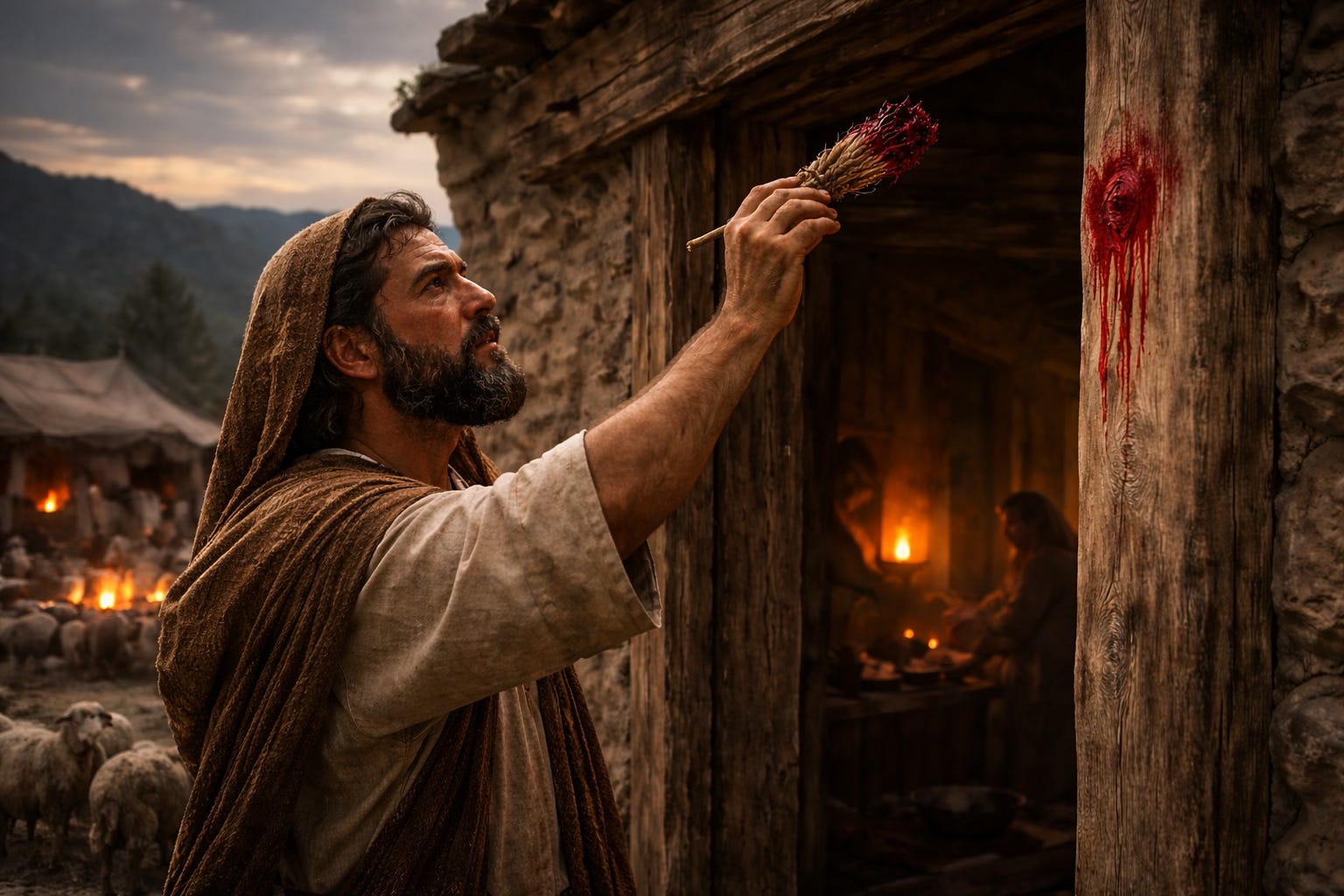
Exodus says the blood is an אות (ot, sign) on the houses.
That’s covenant marking.
Not drinking.
Passover is זִכָּרוֹן… remembrance that forms identity
Exodus calls Passover a memorial—remembrance carried “throughout your generations.”
So Passover is not nostalgia. It’s covenant identity formation.
Passover is זֶבַח… sacrifice language
Exodus explicitly names it: “זֶבַח־פֶּסַח” (a Passover sacrifice).
So Passover sits inside Israel’s sacrificial world… while still being uniquely “house-marking” in its blood function.
Let that land:
flesh is eaten
blood is applied as a sign
deliverance comes by God’s mercy under God’s terms
That’s the Torah template John 6 is leaning on.
John 6 is Exodus 16 all over again… manna, grumbling, and control
The feeding of the 5,000 isn’t just compassion. It’s deliberate wilderness theater:
hungry crowd
wilderness vibe
supernatural bread
leftovers and abundance
then… the crowd pivots into demand and control
They want a king they can use.
That’s the old sin: God’s provision… minus God’s terms.
And Torah already told you what manna was meant to teach:
Man doesn’t live by bread alone… but by every word that proceeds from the mouth of YHWH.
So when Messiah says, “I am the bread of life,” this is not metaphor fluff.
It’s covenant claim.
It’s God’s provision walking toward them.
And that’s why they grumble… because divine claims inside a Jewish frame feel like an invasion when you’re trying to stay in control.
Before the scandal line… John gives you the interpretive key
This matters because it blocks a lot of bad theology right at the start.
Messiah defines the “eating” in relational terms: coming, believing, abiding.
So the chapter itself tells you the “consumption” language is covenant reception language.
And then… the discourse goes nuclear.
“Eat my flesh and drink my blood”… expanded until there’s no fog left
Let’s be blunt… and careful… and beyond reproach.
Yeshua is not endorsing cannibalistic behavior
No. Full stop.
And we don’t have to argue that from modern sensibilities. Torah itself makes it unavoidable.
Blood-drinking is forbidden in Torah
If “drink my blood” were a literal instruction, it would be a direct collision with Torah’s repeated prohibitions.
So a Torah-faithful Jewish Messiah is not commanding Torah violation at Passover.
That’s not a theological preference. That’s basic covenant literacy.
Cannibalism is covenant curse horror in the Tanakh
Want to know how Torah and the Prophets treat cannibalism?
Not as worship. Not as covenant participation.
As horror… as breakdown… as covenant curse conditions under siege.
Leviticus and Deuteronomy warn it as covenant curse. Kings and Lamentations record it as devastation.
So if someone says, “John 6 teaches cannibalism,” they are forcing Messiah to contradict the moral universe of the Scriptures He lived inside.
That’s not interpretation. That’s category collapse.
Hebrew Scripture already uses “eating” as internalizing
This is where the Masoretic worldview helps you breathe again.
The Tanakh uses embodied “eating” language for internalization:
Jeremiah: “Your words were found… and I ate them.”
Psalms: “Taste and see…”
Ezekiel: “Eat the scroll.”
Nobody reads those as literal dietary instructions.
They’re covenant idioms: receiving something until it becomes part of you.
So when Messiah uses “eat/drink” language in a Torah world where literal blood-drinking is forbidden… He is doing what prophets do:
He’s using embodied shock language to force a decision about allegiance.
Passover itself supplies the exact template
This is the cleanest Torah anchor:
Passover already taught Israel how flesh and blood function in redemption:
flesh eaten as covenant meal
blood applied as covenant sign
deliverance by mercy under God’s terms
So when Messiah speaks of flesh and blood at Passover time, the Jewish frame screams:
“This is covenant participation language… not literal cannibal instruction.”
What about John’s vivid eating language later?
Yes, John uses more vivid eating language later—and people love to weaponize that.
But vivid language doesn’t rescue a literal blood-drinking reading. Torah still governs what “literal” could possibly mean here.
At most, the vividness intensifies the point:
This isn’t casual association. This is total reception… total allegiance… the kind of union you can only describe as consuming.
And John 6 itself kills “mechanism religion”
Messiah says the Spirit gives life… His words are spirit and life.
That’s the chapter correcting the exact move man-made religion loves:
turn covenant into technique
relocate life into the ritual pipeline
make access controllable
John 6 will not let you do that… unless you ignore the chapter’s own interpretive guardrails.
(And to be crystal clear: this isn’t denying embodiment or the incarnation. It’s denying salvation-by-technique. Messiah is life. The Spirit gives life. His words are life. That’s the emphasis.)
Communion got flattened… because men kept the symbol and lost the story
The core issue is not “weekly”… it’s story-loss and meaning-relocation
Early believers did gather and break bread regularly. So the villain isn’t frequency.
The strongest, fairest critique is this:
You can do the meal often… and still commit the real error…
detaching the meal from Passover depth and relocating meaning into an institutional mechanism.
That’s when you get the deadly swap:
covenant remembrance becomes routine
proclamation becomes transaction
dependence becomes technique
Messiah becomes a controllable product
That’s not “church.” That’s religious industry.
Why Rome becomes part of this conversation
Rome is not the only tradition capable of flattening. Protestants can flatten too—just in different ways.
But Rome is the clearest example of a defined sacramental metaphysic: a strong claim about Christ being “truly, really, and substantially” present in the Eucharist, with formal doctrinal development around how that works.
Here’s the point, stated carefully:
When John 6 is treated like a mechanics manual for sacramental presence—rather than Passover-shaped covenant speech—the chapter gets pulled out of its Jewish bloodstream and recruited into institutional categories it wasn’t written to carry.
And that’s how men build man-made religion with Bible verses.
(Also fair to say: many Catholics approach the Eucharist in sincere reverence and faith. My critique here is not “Catholics are evil.” It’s the interpretive move that turns John 6 into a mechanism—especially when that move detaches it from Torah blood-law and Passover structure.)
The invitation… learn Passover so you stop outsourcing your Bible
I’m going to say this plainly because it’s right:
If believers want to understand communion, they need to recover Passover’s depth.
Not as cosplay. Not as performance. Not as “being Jewish to be saved.”
As discipleship.
Because Passover teaches you the redemption grammar the New Covenant is speaking in:
deliverance from slavery
mercy under blood
covenant identity
remembrance as formation
provision in the wilderness
dependence, daily… not control
So yes… I encourage you to learn a Passover dinner. Start simple:
Read Exodus 12 out loud
Notice what happens with flesh and what happens with blood
Let the story do its work on you
Then go back to John 6 and ask the question Torah forces you to ask:
What kind of “eating and drinking” could Messiah be demanding in a world where blood is forbidden as food?
Answer: covenant reception so total it can only be described as consumption.
That’s the depth.
That’s what got stolen.
May the shalom of our Abba guard you —
shalom v’shalvah.
Your brother in The Way,
Sergio.
Always connected the institution of the new covenant established in Christ's blood wit the Passover because Jesus himself said to his disciples "How I have longed to eat this Passover with you." The life is in the blood Leviticus 17:11 so when Jesus says to drink his blood is obviously metaphorically as blood is sacred and must not be infested into the human body Acts 15:29, he was saying if we are eating and drinking him consuming him, abiding in him, whom he is,his character, nature image likeness and faith, we then have his very life coursing in and through us. By the Lord, the spirit. whoever says he abides in him ought to walk in the same way in which he walked. 1 John 2:6
Even worldly people understand these concepts when they say inane things like I eat drink sleep TV. How is it then, those who say they belong to the living Christ Jesus cannot? Everything is a seamless red thread a tapestry woven beautifully together like the high priests seamless tunic that Jesus also wore and was cast lots over by the Roman soldiers, se another wonderful hidden treasure as Jesus is the true ad final high priest after the order of Melchizedek, from the beginning to the end the Alpha and the omega you will not find or grasp the wonderful hidden treasures revealed in the living Christ Jesus if you don't spend the time in knowing all the types and shadows revealed before from Genesis to Malachi. Yet truly these things are only illuminated and revealed when you spend time in holy intimacy with heavenly father, sitting at Jesus' feet and God's very own holy spirit whom by is grace will reveal these exquisite eternal priceless treasures that are far more valuable than inanimate money or objects! These are the many wonderful gifts and presents from our loving heavenly father and from Himself whom: Every good gift and every perfect gift is from above, coming down from the Father of lights, with whom there is no variation or shadow due to change. James 1:17
This article requires 2 cups of coffee, not ‘just the one’ that Sergio suggests.