
📬
Sign Up for Our Amazing Newsletter!
Writing result-oriented ad copy is difficult, as it must appeal to, entice, and convince consumers to take action.
A thinker who builds. A builder who questions.
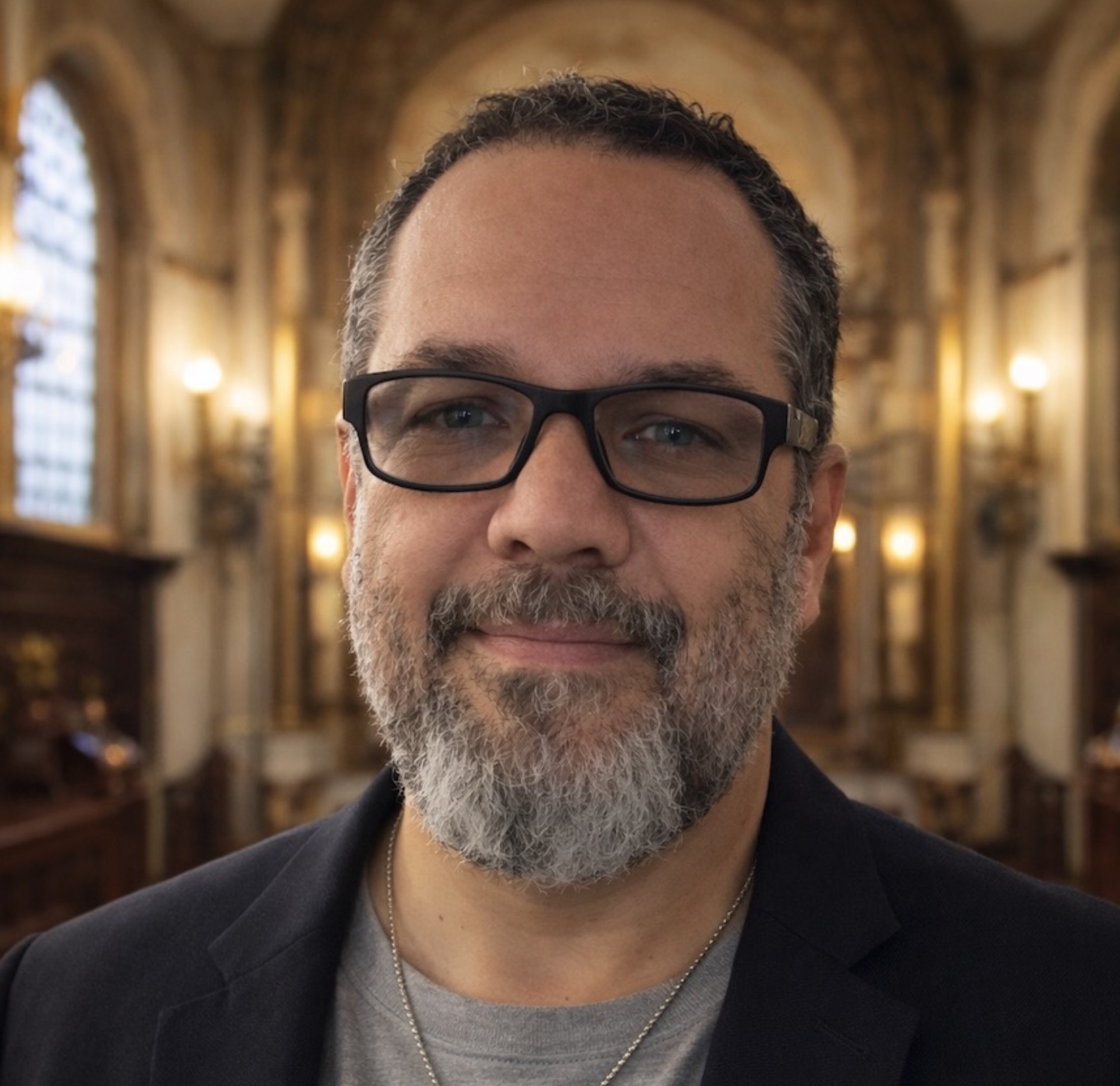
Sergio DeSoto | The Counterintuitive Thinker™
A thinker who builds. A builder who questions.
My first language was Castilian Spanish. My father wasn't in the picture. My mother — a single mom who worked harder than anyone I've ever known — raised me with one non-negotiable: words. She'd leave vocabulary lists in the bathroom. The bigger the word, the happier she was. English was my second language, and she made sure I learned it like a weapon.
I dropped out of high school at sixteen because I got my girlfriend pregnant.
Most bios don't start there. Most bios start with credentials, accolades, a carefully curated trajectory that makes the author look inevitable. I'm not inevitable. I'm a high school dropout who had to grow up fast, figure things out in real time, and pay for every lesson the expensive way.
That girlfriend? I married her. Thirty-three years ago. We have six children. And the only reason that marriage survived — through job losses, business failures, financial free falls, health crises, and the kind of arguments that make the walls thin — is because we both had a stubborn, sometimes white-knuckled faith that the covenant meant something even when we didn't feel like it did.
I'm not writing that to impress you. I'm writing it because if you're going to read what I publish here, you should know who's behind it.
"My life verse — 1 John 2:6 — because whoever claims to live in him must walk as Yeshua walked. Not as Rome decided he walked. Not as Geneva reformulated him. Not as Nashville packaged him. As a Torah-observant, Second Temple Jew who kept Shabbat, honored the feasts, and called the religious establishment to account. If the feet don't follow the actual Yeshua, the confession is just branding."The short version nobody believes
I got my GED at seventeen — and scored high enough to receive a personal letter from the President of the United States. The high school dropout whose first language wasn't even English outperformed the system that lost him. Earned an associate's degree in advertising and design — the only degree I have. Everything else, I taught myself.
I read three to five books a month. I have for years. History, theology, business, psychology, language, leadership — anything that sharpens how I think. Formal IQ tests put me in a category that makes the dropout story even harder to explain. The system looked at young man trying to be and adult with a pregnant seventeen-year-old girlfriend and saw a statistic. They weren't looking at the right numbers.
I got fired from corporate America over an overseas concrete issue. Walked into a sign shop. Learned the trade. Started my own shop. Turned it into a vehicle wrap company — one of the first in the country doing custom wraps, not just fleet marketing graphics. Along the way, I invented The Bad Wrap™, the world's leading vehicle wrap design software.
A high school dropout who pioneered an industry and built the software that runs it.
Nobody in the guidance counselor's office saw that coming.
What I've actually done
I've built and operated companies across sign fabrication, vehicle wraps, marketing and advertising consulting, and software development. I've consulted for organizations ranging from small shops to managing very specialized projects for 3M as well as being the CMO of the largest sign supplier in the world. I've led marketing strategy, audited agencies, designed systems, and built tools that people use every day.
I've also been fired more times than I'd like to admit. Not because I couldn't do the work — but because I think in layers. I see the thing behind the thing. And in most rooms, the person who sees three levels deep while everyone else is still on level one isn't rewarded for it. They're shown the door.
It took me a long time to realize that wasn't a defect. It was the whole point.
What I carry
I'm not going to list my hardships like medals. But I'll tell you plainly: I've walked through seasons that should have ended me — financially, physically, relationally. Some of them nearly did.
I carry regret. Real regret — not the kind you perform for an audience, but the kind that sits in your chest at 2 a.m. and teaches you things success never could.
I also carry refinement. Every failure burned something away that didn't belong. Every season of loss clarified what actually mattered. I'm not who I was at sixteen, or twenty-five, or forty. And I wouldn't go back to any of those versions — not because they were worthless, but because the fire made this version sharper.
Why I write
I write because I spent too many years inside systems — corporate, religious, cultural — that rewarded compliance and punished the kind of thinking that actually moves the needle.
I write because I believe most people have never been given permission to think for themselves. Not really. Not about the things that matter most — faith, identity, purpose, the institutions they trust with their families and their souls.
I write because I sat in churches for decades and heard things presented as biblical truth that couldn't survive ten minutes with a Hebrew lexicon and an honest question. And when I started asking those questions — not to tear anything down, but because the text demanded better answers — I found a faith that was deeper, older, and more alive than anything I'd been sold from a stage.
People look at the name DeSoto and hear Spanish. They're not wrong — but the story behind it is older than Spain wants to remember.
My family is part of the Jewish Diaspora — Sephardic Jews whose lineage traces back through the Iberian Peninsula, through centuries of expulsion, forced conversion, and survival under names that don't sound Jewish to most ears. But DeSoto is a Sephardic name. It carried Jewish blood through generations that had to hide it to stay alive.
What most people don't know is that I'm a unique blend — half Ashkenazi, half Sephardic. Both streams of the Diaspora, both histories of displacement and preservation, running through one person. The Eastern European story of pogroms and endurance on one side. The Spanish story of inquisition and hidden identity on the other.
So when I say I'm a Jew who follows Yeshua, that's not a theological position I adopted. It's a homecoming. I study Torah not as a relic but as a living covenant — the covenant my ancestors bled to keep. I read the Tanakh and the Brit Chadashah in their Hebraic context because that's what they are — Jewish texts, written by Jewish authors, to Jewish audiences, about a Jewish Mashiach. The Greek and Roman and Western Protestant layers came later. I want to get underneath them — and for me, that's not an academic exercise. It's personal. It's family.
B'Chavruta (בְחַבְרוּתָא) — "in partnership" — is the theological heart of this site. It comes from the ancient Jewish tradition of studying Scripture in pairs: two people at a table, wrestling with the text as equals. No hierarchy. No pulpit. That's what I'm offering you. Not a lecture. A seat at the table.
What you'll find here
Faith — Hebraic theology, covenant studies, Hebrew and Greek word studies, and the kind of exegesis that takes the text seriously enough to challenge what you've been taught.
Family Life — Lessons from thirty-three years of marriage, six kids, and the kind of honesty that only comes from getting it wrong and staying in the room anyway.
Religion — The distinction between faith and religion is deliberate. Faith is your covenant walk with HaShem. Religion is what institutions do with that walk — and it deserves examination.
Business — Everything I know about building, leading, failing, and rebuilding — learned without a safety net, without a pedigree, and without anyone's permission.
The real reason
I want you to enjoy truth. Not endure it — enjoy it.
I want you to think for yourself — not because authority is bad, but because lazy thinking is dangerous and most people have never been taught the difference.
I want you to experience real shalom with your Maker — not the fabricated version sold from a platform, but the kind that comes from sitting with the text yourself, asking hard questions, and discovering that HaShem is more present in the wrestling than He ever was in the performance.
And I want you to see what I've seen: that when you read the Bible from its Hebraic perspective — in the language it was written, inside the covenant it was given — it stops being a flat religious book. It becomes three-dimensional. Alive. A story so beautiful and so layered that you wonder how you ever read it any other way.
That's why I built this place. That's why I write. That's why the table has an empty chair.
It's yours if you want it.
Shalom,


Welcome to the table
Featured Posts
The Grave Was a Mikvah

YHWH as Yovel



