



Two men stood at podiums in Orlando, Florida and argued about baptism for two hours.
Dr. James White, Reformed Baptist Calvinist. Dr. Greg Strawbridge, Paedobaptist in the Westminster tradition. Both had clearly read everything worth reading inside their respective systems. Strawbridge argued the gospel goes to households — you and your children, covenant to covenant, Abraham to Acts. White argued the New Covenant documents have to define the fulfillment of Old Covenant types, not the other way around.
What neither man questioned was the cage they were both standing in.
Both positions are downstream of a Western Reformed theological framework that Augustine shaped, Calvin systematized, and Constantine made possible. Neither podium was asking whether that framework itself was the problem. They were debating the fine print of a contract whose legitimacy neither had examined.
That's not a debate about Scripture. That's a debate about which tradition gets to win.
The Building Down the Street
Christ's Church of the Valley has nine campuses across the Phoenix metro. When you show up for the first time, someone meets you at a designated Guest Table and gives you a free gift. Your kids get checked into their classroom — infant through sixth grade available at every service. Junior high and high school meet in Building 4000. The kiosk registers your child's name tag. You get a matching pickup receipt.
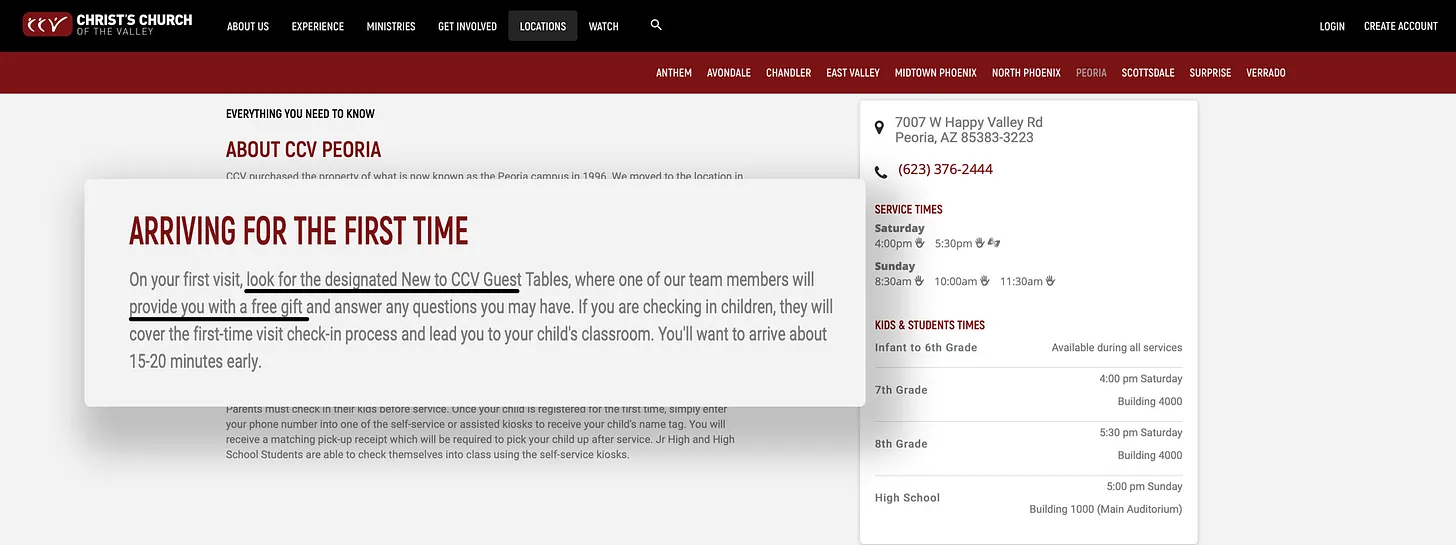
This is not a fringe church. This is one of the largest and most influential congregations in Arizona, with Saturday evening and Sunday morning options to fit your schedule.
Now: where in the debate about covenant membership, baptismal candidates, and New Covenant hermeneutics does this get addressed?
It doesn't.
The Question Nobody Asked
Both White and Strawbridge were asking: Who should be baptized?
Neither one was asking: What are we actually forming people into?
And that's the gap. Because the mechanism by which CCV operates is not primarily theological — it's logistical. It's designed to reduce friction, maximize attendance, and keep people coming back. The free gift isn't grace. The kiosk isn't covenant. The pickup receipt is not the mark of belonging to the body of Mashiach.
The Acts 17:11 Bereans that everyone loves to quote weren't commended for showing up on time, finding good parking, and enjoying the worship band. They were commended for anakrinō — the Greek term for judicial cross-examination. They interrogated what they heard against the text. That is a different posture than the one a Guest Table gift is designed to produce.
Sha'ul (Paul) told the Ephesians: "We are to grow up in every way into him who is the head, into Messiah, from whom the whole body, joined and held together by every joint with which it is equipped, when each part is working properly, makes the body grow so that it builds itself up in love." (Ephesians 4:15–16, CJB)
Every part working properly. Not every part receiving services and checking their children in.
What the Marines Actually Reveal
The original framing of this essay used the U.S. Marine Corps as an analogy, and it's worth keeping — because what makes the Marines instructive isn't their commitment level. It's their clarity about what they're building.
A Marine recruiter does not promise you a comfortable experience. He tells you what you'll lose and what you'll gain. He tells you what the mission is. He tells you that the transformation is irreversible — you don't stop being a Marine when you leave the building.
Most of what passes for church in America operates on the opposite assumption: come when you can, give what's comfortable, belong without cost. The Guest Table gift is a tell. It communicates: we want you here more than we need you transformed.
Now — is that the whole picture? No. There are sincere shepherds inside large institutions doing real work at real cost. This isn't about individuals. It's about the model, and what the model produces.
Because the model produces consumers. And consumers don't carry burdens — they shop for the lightest one.
What the Debate Actually Got Right
White said something worth marking: "The difference is between purposefully giving the ordinances of the New Covenant to individuals for whom you have no warrant whatsoever to believe that they are repentant and believing — and following the apostolic example which is to ask for that profession of faith."
The apostolic example asked for something. It required something. It was costly to enter the early community in a world where confessing Yeshua could get your family killed. That's not melodrama — that's Acts 8, Acts 12, the Neronian persecution, the Domitian era. The book of Hitgalut (הִתְגַּלוּת — Revelation) was written to people for whom confession was a death sentence.
The libellus system under Roman imperial enforcement — the document you had to obtain certifying you had offered incense to the emperor's genius — was the mechanism of social compliance. The early community refused it at cost. They weren't being edgy. They were being covenantally faithful to Yeshua as the only true Lord, kyrios, in a world where Caesar claimed that title.
You cannot build that kind of community with a Guest Table gift.
The Real Question About Baptism
White and Strawbridge spent two hours on who receives the sign. The question beneath that question — the one neither podium addressed — is: what does the sign mean if the community it initiates you into has no weight, no cost, no mutual accountability?
Yeshua said the New Covenant is in his blood. (Luke 22:20) Covenant in the Hebrew tradition — brit (בְּרִית) — is not a membership card. It is a binding, oath-sworn, blood-ratified commitment with stipulations. Blessing for faithfulness. Consequence for breaking it. The whole structure of Hebrews 10 that both debaters kept circling assumes a community where breaking covenant means something because belonging to the covenant costs something.
A covenant community that hands you a gift on your first visit and checks your kids into Building 4000 has not answered that question. It has just organized around avoiding it.
Selah
If the community you attend asked something costly of you to enter — would you still be there?
What does your church form people into, and how would you know if it was working?
Is the structure of your church designed to produce disciples, or to retain attendees — and do you know the difference?
May HaShem grant us the courage to be part of something that costs us something. Shalom v'shalvah.
Your brother in the Way,
Sergio
Copyright © Sergio DeSoto. All rights reserved. You are welcome to share this with attribution and a link to the original. No reproduction for commercial purposes without permission.


.jpg)


