

Kavod in Hebrew equals weight. Heaviness.
The gravitational substance a presence carries when something true walks into the room. In the Tanakh (Hebrew Bible) it belongs to HaShem (the Name) exclusively. A pastor never owns kavod. He reflects it. The moment he starts collecting it for himself, he has stolen from the only One it was ever pointed at.
"I invite you with great joy to join Jesus in building His church by giving prayerfully and generously to the Lives and Legacies Building Fund Campaign."
That sentence is from the Legacy page at trinitychurch.com. Read it again. The kingdom of Yeshua (Jesus) and the named fundraising drive of a Scottsdale corporation have been welded into a single act. To give to one is to join the other. The Campaign is the church-building. The church-building is the Campaign.
Everything that follows is naming what the page has already confessed.
The Mishkan Counter
YHWH does not ask Moshe (Moses) for a building fund.
The instruction in Shemot - Exodus 25:2 is terumah, a freewill offering, and the qualifier is kol ish asher yidvenu libo, from every man whose heart stirs him. The repetition matters. Shemot - Exodus 35:5, Exodus 35:21-29 all hammer the same note. Stirred-hearted. Willing-hearted. Freely offered. There is no quota. No campaign weeks. No giving statement compared to last year's pledge. No stretch-faith donor tier.
Then comes Shemot - Exodus 36:5-7. The craftsmen go to Moshe with a problem. The people are bringing more than enough. So Moshe issues a command, a single command, and it is the inverse of every capital-campaign sermon ever preached. Let neither man nor woman do any more work for the offering of the sanctuary. The giving had to be stopped. Restrained. The flow of stirred hearts was too much for the work that the work required.
And the named craftsman. Bezalel ben Uri, of the tribe of Yehudah (Judah), filled with the Ruach HaKodesh (Holy Spirit) for wisdom, understanding, knowledge, and all manner of workmanship. Shemot - Exodus 31:1-5. Shemot - Exodus 35:30-35 names him once more so the people know who is doing the work. After that, the Torah largely sets him aside and lets the curtains, the boards, the bronze, the gold, the ephod speak for themselves. Bezalel is not on the Mishkan's homepage. He is not the brand. The work is the brand. YHWH is the brand. Bezalel is the hand.
There is no debt anywhere in the account.
The Fear Question
From the same page: "We refuse to stand before Jesus Christ at the end of this life having apologized for not dreaming big, giving sacrificially, and living by faith."
Set that next to Devarim - Deuteronomy 6:13 and Deuteronomy 10:12, where the covenant fear of Israel is yirat HaShem, the fear of YHWH. Fear of breaking covenant. Fear of idolatry. Fear of forgetting the One who brought you up out of Mitzrayim (Egypt). Mishlei - Proverbs 1:7 and Proverbs 9:10 call this fear the reishit, the beginning, of wisdom and knowledge. It is the orientation that keeps a covenant people from becoming a market.
The fear on the Legacy page is something else. It is the fear of underperforming. The fear of arriving at the bema of Mashiach (Messiah) with a smaller building, a smaller campaign, a smaller dream. The fear is structured as a performance review with Yeshua as the disappointed shareholder. Did you scale? Did you stretch? Did you dream commensurate with the market opportunity?
Yirat HaShem trembles before holiness. The Legacy fear trembles before mediocrity. They are not the same fear. They are not even the same direction.
The Pronouns
Count them, slowly, when you read the page out loud.
Pastor Mark this. "I invite you. I am more excited than I have ever been. I have preached. My 30 years of ministry. I'll give you the vision that God has for the future of our church. I'm going to ask you to provide the provision."
That last sentence, quote seven on the page, is doing two jobs at once. It assigns vision-casting to the senior pastor and provision-producing to the congregation. Structurally, it is the inverse of Shemot - Exodus 35-36, where YHWH casts the vision through Moshe, Bezalel executes the craft, and the people overflow the work with stirred hearts. The hierarchy on the Legacy page runs visible-man, then God, then audience. The hierarchy in the Mishkan runs YHWH, then anonymous people, then a craftsman whose name appears on the page once.
Now stand the Legacy page beside Vayikra - Leviticus 16. The Kohen Gadol (High Priest) enters past the parochet, the veil, into the Holy of Holies on Yom Kippur alone. No camera. No worship band swelling underneath. No live-stream. Plain linen. The most sacred act in the covenant calendar happens in a room where no human eye sees it. The work is hidden because the audience is YHWH.
Yeshua already named the contrast. Matthew 23:5-7. The phylacteries widened. The fringes lengthened. The chief seats at banquets. The greetings in the markets. All their works they do to be seen. The Levitical priest in plain linen behind the parochet and the megachurch senior pastor on the homepage are not on a continuum. They point in opposite directions. One vanishes into the smoke. The other vanishes into the brand.
The Debt Question
The verified numbers, lest anyone accuse a brother in the Way of speaking past the page. $15.5M for the 116,200 square-foot former office complex at 10001 N 92nd St in Scottsdale. $2.765M down. $12.735M financed through AG Financial Solutions, an Assemblies of God affiliated lender. Closed January 5 2026. Campaign launched March 14 2026.
Devarim - Deuteronomy 15. Every seventh year, shemittah, a release. Every creditor relaxes his hand. Debt in the Torah is a bondage to be released, not a fuel to be deployed. The economy of YHWH runs on stirred hearts and periodic release. The economy of a building fund runs on a thirty-year amortization and a pledge card.
Ask the question the page will not ask. Who carries the $12.7M? Not the founder. Not the pastor on the homepage. The next twenty years of stirred-hearted givers carry it. A young family that joins in 2028 will be paying interest on a mortgage signed in 2026 by a senior pastor whose name they will read on the homepage. That is not Bezalel's pattern. That is Pharaoh's pattern. The straw and the bricks.
The Mishkan was paid in advance, by gifts that had to be restrained. The Campaign is paid in arrears, by gifts that have to be solicited.
A Field Note: The Growth-Building Growth Schema
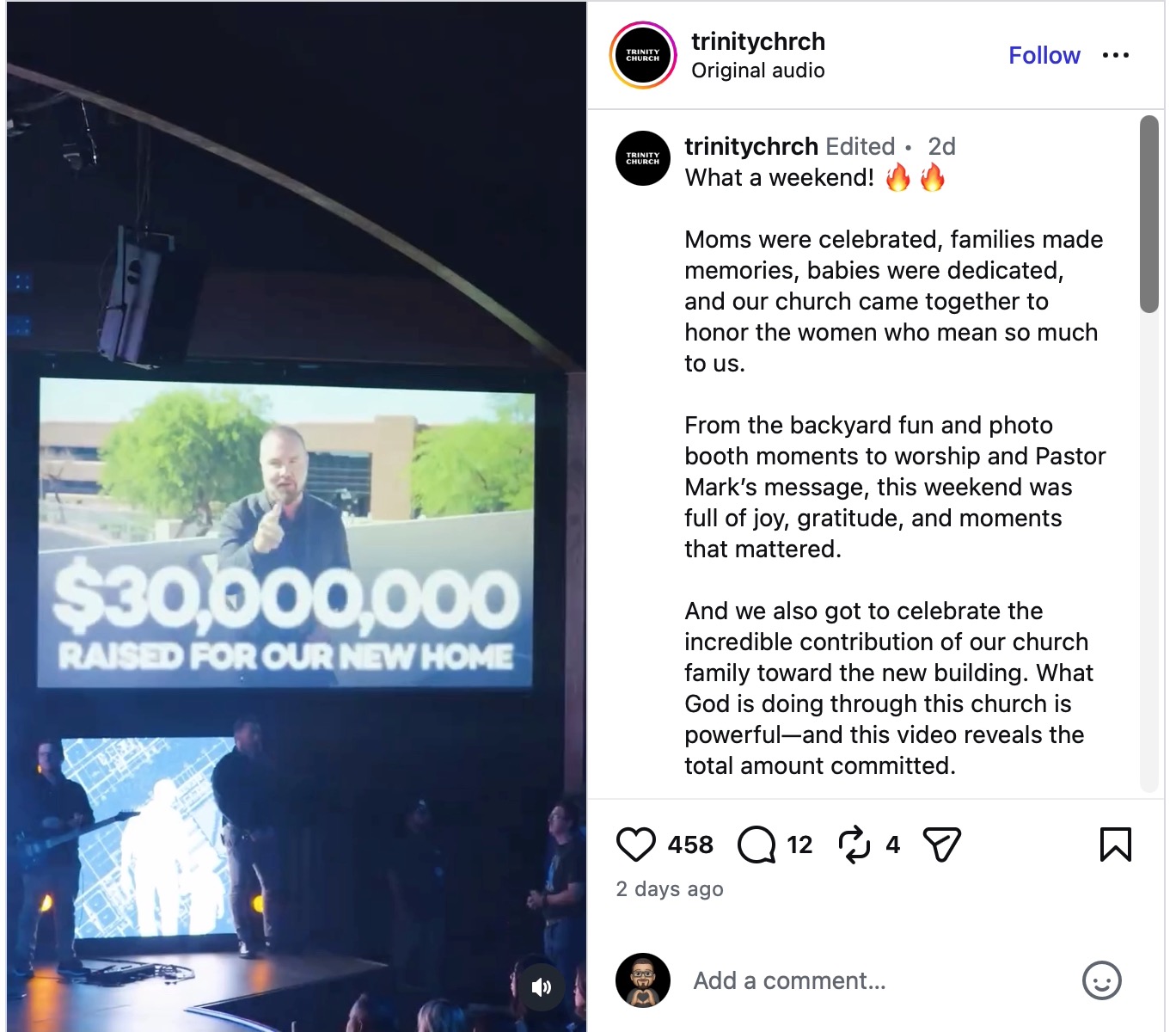
This is not a new scheme. Pastors talk to each other. I have watched the exact same pattern run in three other churches in this area: 14-6, Compass, and Desert Springs. The mechanics are consistent enough to have a name. Call it the growth-building growth schema.
The schema runs in five beats.
One. Announce a building campaign. The cost gets framed as a stretch.
Two. Solicit pledged commitments. The total committed becomes the headline number, often shared from the platform as social proof. We have $28M in commitments. We have $30M in commitments. The social-proof number is the gravitational center of the campaign, not the building cost.
Three. The commitments come in higher than the actual building cost. In this case, the building is $15.5M. The campaign collects pledges well above that line.
Four. Put a small fraction down in cash and finance the rest. Trinity put $2.765M down and took a $12.735M loan, even though the campaign was raising more than enough to pay outright. Why borrow when the cash is coming in? Because the loan is the point. The loan preserves the cash on the balance sheet.
Five. The church ends up with several million dollars of liquidity it did not have before the campaign began. The building gets built. The loan gets serviced over thirty years by the next generation of givers. And the church has new cash on hand that no campaign-week communication ever mentioned.
The givers think they are giving to a building. They are giving to a building and to a balance sheet. Both. The building is the visible artifact. The balance-sheet liquidity is the invisible second artifact. The campaign communications cover the first and not the second.
This is the schema. The reason it survives is that the second artifact never appears on the giving page. The reason it spreads is that pastors share what works with other pastors. The reason it works is that the commitments themselves manufacture the validity that produces the next commitments. The number on the platform is what tells the next giver that the number is real.
The Mishkan account does not have a balance-sheet artifact. The Mishkan account has too-much-given and a counter-command to stop. The growth-building growth schema is the inverse of kol ish asher yidvenu libo in every direction.
The Language of Empire
"Scottsdale will remain our forward operating base for generations to come."
"Trinity Church will fight for Arizona families and stand as a firewall against the spread of secular ideology in politics and culture."
The qahal of Israel was not a base. It was a gathering, qahal YHWH, called out to stand before the face of the Holy One. The military-political register on the Legacy page is not biblical, and it is not Hebraic. (The phrase forward operating base has the cadence of a Pentagon briefing, which is, charitably, where it was probably borrowed from.) It is the vocabulary of late-stage American civil religion, in which the local congregation is reframed as a forward operating base, the surrounding culture as enemy territory, and the 250th birthday of the United States as providential timing for a Scottsdale real-estate acquisition.
This is the language of empire wearing a cross. The kingdom of Yeshua does not have forward operating bases. It has talmidim (disciples). It has tables. It has feet that get washed. Hesed, covenant loyalty, steadfast love, is not a firewall. It is the opposite of a firewall. It is what makes the wall come down.
And then "Forever Family." That phrase, deployed in a sentence about an American megachurch's generational vision, quietly does what most replacement theology does. It substitutes a new corporate entity for the olive tree of Romans 11, into which the nations have been grafted by hesed and not by purchase. Sha'ul (Paul) is unambiguous in Romans 11:18. Do not boast against the branches. The Legacy page boasts against the branches by not noticing they exist.
What Korach Did
The Torah has a word for this illness. It is not a metaphor. It is not a soft word. It is ma'al. Sacrilege. The misappropriation of what belongs to YHWH for personal use.
When Achan kept silver and gold and a Babylonian garment from the cherem of Yericho, the Torah called it ma'al. Yehoshua - Joshua 7. The whole assembly bled at Ai until the ma'al was named and removed. When Uzziah HaMelech (King Uzziah) burned incense at an altar that was not his to serve, YHWH struck him with leprosy on his forehead in front of the kohanim. 2 Divrei HaYamim - 2 Chronicles 26. Ma'al. When Korach (Korah) gathered 250 named men, princes of the assembly, men of renown, and said to Moshe and Aharon (Aaron) you take too much upon yourselves, since all the assembly are holy, the earth opened under his feet and the fire of YHWH consumed his coalition. Bamidbar - Numbers 16. Ma'al. The bronze censers of the 250 were hammered into a covering for the altar as a perpetual sign to Israel that the priesthood is not seized.
Read Bamidbar - Numbers 16 next to the Legacy page. Korach's coalition was 250 princes called to the gathering, men of renown. The Legacy page is a coalition of campaign donors named on giving statements, identified as the Forever Family. Korach's framing was all the assembly are holy, true at face and functioning as cover for self-elevation into the priestly office. The Legacy page's framing is join Jesus in building His church, true at face and functioning as cover for self-elevation into the senior-pastor office of mediator. Korach gathered men of renown. The Legacy page gathers men of renown. Korach offered incense. The Legacy page offers a Building Fund. The Korach pattern does not survive the encounter with YHWH. The earth opens. The fire falls. The censers are repurposed into a warning.
And the shepherds. Yechezkel - Ezekiel 34. Woe to the shepherds of Israel who feed themselves. Should not shepherds feed the flock? You eat the fat. You clothe yourselves with the wool. You slaughter the fat ones, but you do not feed the flock. With force and harshness you have ruled them. The 116,200 square feet, the $12.7M mortgage, the senior-pastor homepage, the forward operating base, all of it is the fat shepherd. Yechezkel does not soft-pedal this. He names them as the enemies of YHWH and prophesies that YHWH Himself will become the shepherd.
The lineage runs through the whole Tanakh. Bavel (Babel) said let us make a name for ourselves. Bereishit - Genesis 11. Pharaoh said who is YHWH that I should obey His voice. Shemot - Exodus 5. Nebuchadnezzar said is this not great Babylon, which I have built. Daniel 4. Herod accepted the cry the voice of a god, not of a man and did not give the kavod to YHWH and was struck. Acts 12. I am YHWH. That is My name. My kavod I will not give to another. Yeshayahu - Isaiah 42:8. The Tanakh treats the disease the same way every time. The disease has a name. The Tanakh named it three thousand years before the Lives and Legacies Building Fund.
The Fruit and the Root
A note for the record, and only one. The pastor whose name is on the Legacy page resigned from Mars Hill Seattle in October 2014, with his own board's finding citing arrogance, quick temper, harsh speech, and domineering leadership, alongside public allegations of plagiarism and the use of church funds to promote his books. That is the public record. It is one sentence in this piece for a reason. The piece is not about him. He is the fruit. The root is the page.
Any community that produces a Legacy page like this one would produce, within a few years, a senior pastor like the one whose name is on it. The page is the system. The system selects for the man. The man is downstream of the kavod that has already been redirected.
So look at the type, not the man. The senior pastor who builds a capital campaign of this shape, who shipwrecks in one city and rebuilds in another, who frames the giving page as a joint venture with Yeshua and the building as a legacy, is a recognizable profile. Alfred Adler named the engine almost a century ago. The visible striving is for significance at scale. The felt inferiority underneath the striving is older than ministry. A boy somewhere learned early that being small was being unsafe, and the adult compensation built rooms that required him at the center. Forward operating base and Forever Family are not rhetorical accidents. They are a Lebensstil, a life-script formed in childhood, speaking through the strategic plan.
Adler called this striving on the useless side. Useful striving contributes to the community and lets the work outgrow the worker. Useless striving elevates the worker above the work. Bezalel is the useful-side type. He is named once, and the curtains speak for him. The man on the Legacy page is the useless-side inversion. His name is on the page, the work is named after the campaign, the campaign is named after the legacy. Each layer of branding is the same compensation speaking a little louder.
The harshest beat of the Adlerian read is Gemeinschaftsgefühl, social interest, Adler's metric for psychological and moral health. It measures how connected a person feels to the human community as one-among-many rather than one-above-many. High social interest looks like Bezalel inside the qahal. Low social interest looks like a man who refines a congregation into an audience and a building into a monument. That is the diagnostic. Not the harsh speech, not the plagiarism, not the book-fund allegations. Those are downstream. The diagnostic is upstream. He cannot connect to the community as a brother. He can only preside over it as a head.
This is why the system finds him so easily. The page is shaped like the wound. The wound was already there. The compensation was already running. The qahal-shaped vacancy at the head of the room had been advertised for years. The Legacy page is what happens when a community structured around useless-side striving meets a Lebensstil that has been training for that chair since long before ministry was on the table. The fit is exact. That is why it works. That is why it is so hard to dislodge.
The Verdict the Page Already Gave
Kavod, in the Tanakh, is the weighted glory of YHWH. Shemot - Exodus 40:34-35. The kavod fills the Mishkan and even Moshe cannot enter. 1 Melachim - 1 Kings 8:10-11. The kavod fills the Beit HaMikdash, the Temple, and the priests cannot stand to minister. Kavod is the thing that pushes human ministry out of the room because the presence of YHWH has filled it.
The Legacy page does the inverse operation. It fills the room with the senior pastor's name, the campaign's name, the building's name, the city's name, and the nation's name, and it calls the resulting density vision for the future of our church. The room has been filled. Just not by YHWH.
When a community can no longer distinguish between the work of the kingdom and a named fundraising drive, the kavod has been redirected. Everything downstream, the celebrity pastor, the debt, the forward operating base, the firewall, the performance fear, the Forever Family, is symptom. The core is kavod theft. The page does not need a critic. It needs a witness who will read it out loud, slowly, in the room where it was written.
The Torn Veil
The parochet tore at the death of Yeshua. And behold, the veil of the Temple was torn in two from top to bottom (Matthew 27:51). Top to bottom. The Father's hand, not a man's. The Kohen Gadol's exclusive room was opened, and the entire architecture of mediator-priest, audience-people, hidden-God came down in a single ripped seam.
The Brit Chadashah (New Covenant) is not subtle on this. Hebrews 10:19-22. We have boldness to enter the Holy of Holies by the blood of Yeshua, by the new and living way that He consecrated for us through the parochet. The boldness is now yours. The room is now yours. The audience with the Father is now yours.
What was the parochet protecting you from? It was protecting you from a system that ran a man between you and YHWH. The veil tore because the system had to die. The Kohen Gadol stepped offstage. The role was retired. No more visible men wearing linen on your behalf. No more named faces standing in the doorway, collecting the provision on the way through.
Now look back at the Legacy page.
Every line on it is a thread being woven back into a curtain. The visible senior pastor. The vision-casting "I." The campaign as the vehicle for joining Yeshua. The audience-people who provide the provision. The forward operating base. The Forever Family. Each one rebuilds a piece of the room that the Father, with His own hand, tore open.
If nothing else, Mark Driscoll is a very good example of why the parochet was torn.
That is not a polemic. That is the logical reading of the text against the artifact. The Father did not tear the curtain because He prefers a particular denomination or stream. He tore it because He did not want any more visible men standing between His face and yours. The Legacy page is, with great joy and a $12.7M mortgage on a Scottsdale office park, sewing one of those men back into the doorway.
The Brother in Fault
Sha'ul gave the apostolic frame for what this piece is doing. Brothers, if a man is overtaken in a fault, you who have the Ruach should restore such a one in a spirit of meekness, considering yourself, lest you also be tempted. Galatians 6:1. Note the verbs. Overtaken. He is the one in fault. Restore. The aim is restoration, not destruction. In a spirit of meekness. The posture is humility, not vindication. Considering yourself. The watchman watches his own feet first. Lest you also be tempted. The same engine that runs in the visible man runs in the witness, and the only honest difference between them is the budget and the audience.
Mark Driscoll is not acting in accordance with the text the Legacy page claims to honor. He is way off. The Mishkan account is in his Bible. Devarim - Deuteronomy 15 is in his Bible. Vayikra - Leviticus 16 is in his Bible. Matthew 23:5-7 is in his Bible. Hebrews 10:19-22 is in his Bible. Romans 11:18 is in his Bible. Galatians 6 is in his Bible. He has thirty years of preaching and a building fund and a homepage on a former Scottsdale office park, and the texts under all of it tell a different story. That is not interpretive difference. That is structural divergence from the corpus he claims to teach. He is a brother overtaken in a fault.
This is what Galatians 6:1 is for. The piece is restoration in writing. The meekness is in the read. The self-examination is in the closing prompt. Every Kohen Gadol-shaped vacancy in the Hebraic order is a vacancy where the writer of this piece could just as easily sit if he is not careful. The Adler read of the type is also a mirror. The same inferiority compensation, the same useless-side striving, the same low Gemeinschaftsgefühl can run in anyone who picks up a pen against a brother. Sha'ul knew. Sha'ul wrote it into the verse.
The Wake-Up
Brother. Sister. If your church looks like the Legacy page, you are not in trouble for going. You are in trouble for staying without seeing.
You hold a Bible. The thing in your hands is tangible. Men compiled it, men translated it, men argued about it for centuries, and the same book is the word of HaShem, the Author still authoring through it. Both at once. You can read it. You have the Ruach HaKodesh inside you. You have boldness to enter the Holy of Holies by the blood of Yeshua. You do not need a senior pastor's vision to access the Father. You never did.
This is not Sola Scriptura in the modern Reformed sense, which still routes you through pastors and confessions and denominations and conferences, with the senior pastor's homepage at the top of the funnel. This is scripture alone in the older, plainer sense. You and the text. You and the Ruach. You and the Father. The mediator role was filled, once and for all, by Yeshua HaMashiach. Anyone else asking for the role is asking for something the Father has already retired by His own hand.
If you want the long version of how we got here, of how the qahal of Yeshua's talmidim slowly became the corporation of someone else's brand, the receipts are catalogued council by council, century by century, on the Ekklesia Timeline. The companion piece on this site is God Said Direct. Man Built Systems. Start with whichever one your eyes can stand first. The pattern is not new. The Legacy page is the 2026 edition of a very old habit.
You are accountable to YHWH, not to men. The veil was torn. Walk through it.
Selah
Read your own church's giving page out loud. Notice the pronouns. Notice the fear. Ask whose name is being built. Then close the tab, open the Tanakh, and remember whose name was already torn open at the parochet for you.
For those with eyes to see.
B'shalom, Sergio
2026-05-15- Go to his website and see if you can find the Gospel. I looked. It was not there.