

There are 613 mitzvot [commandments] in the Torah. Rabbinic Judaism counted them and built a careful fence around them. Western Christianity received the same commandments and ran. It has taught for centuries that these laws are invalid.
Both responses begin with the same mistake. They file the Torah under the wrong category. One files it as a law to be guarded. The other files it as a law to be escaped. Both agree, before they have argued about anything, that what they are holding is a law.
It is not a law book. It is an intimacy document. And almost everything that has gone wrong in how we read it traces back to that single misfiling.
The Submission of the Heart
Let me set down what is not in dispute, so we can spend our attention on what is. We are to submit to the God of the universe. That is not the question. He is the Maker and we are the made, and the made owe the Maker a bowed head. Stated that way it is only sovereignty, and sovereignty is the simple part.
But this is a love story, and a love story asks for the heart. The God who is owed our submission is not content to be merely obeyed. He is after the kind of yielding only a willing heart can give, freely, from a place that has come to want what He wants. It is one matter to bow to a throne. It is another to give your heart to Someone, and to give it gladly, not because you were conquered but because you came to love Him. We are human. He is the God of the universe. And the whole weight of the thing comes to rest on the human heart, which does not yield easily and cannot be forced.
So submission is not dismissed here. It is moved to where it always belonged, the lev [heart]. It stops being the cold tribute a subject pays a sovereign and becomes the warm yielding a beloved gives the One she has finally come to trust. The question the Torah is reaching toward was never only "will you obey me." It is "will you give me your heart." The first can be commanded. The second can only be won. And the whole letter, as we are about to see, is the Father winning it.
The Only Voice We Have
The Torah is the only documented direct engagement we have with the God of creation. It is the only sustained record of His own voice given to humanity, in His own words, with His own emphasis, with His own choice of what to record and what to leave out. Read that sentence twice. There is no other text in human history that makes this claim and is taken seriously as such by the largest civilizations that have ever existed. The Torah is humanity's only sustained encounter with HaShem's own self-disclosure.
That changes everything about how we are meant to approach it. You do not read a self-disclosure the way you read a statute. You read it the way you read a letter from someone who wanted to be known by you.
Lay It on Your Heart
Because that is what it is. It is the testimony of a Father whose face we have not yet seen, given so that we could begin to know who He is. When He tells us to lay His words on our lev (Devarim [Deuteronomy] 6:6), He is not asking for performance. In Hebrew the lev is the seat of mind and will together, the whole inner person. He is not asking us to file the words somewhere. He is asking us to carry Him there.
There is a Hebrew word for the kind of knowing He is after. It is yada [to know], the word for the deepest knowing a person can have, the knowing between a husband and a wife, between a father and a son. He is not asking us to know about Him. He is asking us to yada Him. To know Him the way a son knows the father he loves, not the way a servant memorizes the master's instructions. Hold that word; the whole letter turns on it.
Creation Is Saying the Same Thing
Sha'ul (Paul) understood this. When he tells the Romans that creation itself testifies of HaShem (Romans 1:20), he is not contradicting the Torah. He is amplifying the same thing Moshe (Moses) said at Sinai. Look around. The sky. The birds. The trees. The whole order of things is shouting at you about who HaShem is, whether you stop to listen or not. The Torah is the formal verbal disclosure. Creation is the surrounding evidence. Both point to the same Person, and both keep pointing whether or not anyone reads them rightly.
Now look at what each tradition did with the letter. And before either critique, hear this plainly: there is no triumph in what follows. Both houses were trying to honor Him. That is exactly why the loss is worth grieving.
The First Myth: That the Fence Is the Faithfulness
The hands that built the fence were trying to keep faith. Read that generously, because it is true. Rabbinic Judaism, afraid of failing the commandments, built a seyag [fence] around the Torah. Layer upon layer of safeguard, all of it so that no one would stumble into breaking a command by accident. That is not arrogance. That is a kind of love, the love of a people who would rather build a wall a mile back from the cliff than risk one child going over the edge.
But here is what a fence does over time. The people stop looking at the cliff, then they stop looking at the view beyond it, and eventually they are tending the fence and have forgotten there was ever anything on the other side worth protecting. The Torah warned about this exact substitution, the moment human safeguards become the thing itself: mitzvat anashim melumadah, the commandments of men learned by rote (Yeshayahu [Isaiah] 29:13). The intention was reverent. The effect was that the Person behind the words got buried under the apparatus built to protect the words.
This is the myth: that more fence means more faithfulness. That nearness to the safeguard is nearness to the Father. It is not. You can spend a life perfecting the wall and never once walk out to meet the One it was built around. (See the timeline "The Second Torah" for how the oral apparatus grew up alongside the written word, and "The People of Scripture" for the stream that kept returning to the text itself.)
And to the one who has tended that fence in good faith, hear the rest of the letter before you decide you have been accused. The carefulness was never the problem. The carefulness was love pointed at a Person you were afraid to lose. What is coming is not the end of your faithfulness. It is the thing your faithfulness was reaching for the whole time.
The Second Myth: That the Letter No Longer Applies
Western Christianity, terrified of legalism, did not build a fence. It walked away from the letters. And this departure has a paper trail, name by name and date by date, so let me give you only what can be proven.
Start with the origin, because you cannot call something a departure without it. The apostles did not teach an abolished Torah. Yeshua (Jesus) said He did not come to abolish it, not one yod, not one stroke (Matthew 5:17-19). Sha'ul asked whether faith nullifies the Torah and answered himself: "May it never be. On the contrary, we uphold the Torah" (Romans 3:31). That is the baseline. Everything after is measured against it.
Now the decisive break, and notice that the motive is written in the man's own hand. When Constantine severed the dating of the resurrection feast from the biblical Passover at the Council of Nicaea in 325, he did not give an exegetical reason. He gave an ethnic one. His own letter, preserved by Eusebius, says it plainly: "Let us then have nothing in common with the detestable Jewish crowd" (Life of Constantine 3.18). A generation later the Council of Laodicea formally anathematized Christians who rested on the seventh-day Shabbat [Sabbath] and ordered them to work it instead. The Father's own calendar, His appointed times, His day of rest, legislated out of the church, not because anyone had reread Devarim, but because of a political grudge against a people.
And what the modern pulpit now calls obvious is the sediment that settled on top of that break. The tidy division of the law into "ceremonial" and "moral," so you may keep the part you like and retire the rest, is not from the apostles. It is from Aquinas, in the thirteenth century. The reflex that hears the word "law" and feels only condemnation is sharpened by Luther, in the sixteenth. The flat sentence "we are no longer under law" is handed to the American pew by Scofield, in the twentieth. At no point in that long chain did anyone walk back to Matthew 5:17 and reconcile. They inherited the drift and built on it. (The timelines "Doctrines of Men" and "The 283 Years" lay out each node so you can check the receipts yourself.)
This is the second myth: that the Father's self-disclosure expired. That knowing Him now means knowing the doctrines about Him instead of the words He actually spoke. And the grief of it is the same grief as the fence. A people trying to honor Him set down the very letter where He told them who He is, and then wondered why the relationship felt thin.
Both Myths Are the Same Mistake
Both responses are about submission. The Jewish response wants to succeed at submission. The Western Christian response wants to escape submission. One buried the parameters under tradition. The other threw them out and called it grace. Both tried to handle submission without giving the heart its place. One walled the heart in behind a fence. The other let the heart off the hook. Neither let it be won. And neither one stopped to ask the only question that matters: why did the Father give the parameters in the first place?
That is the root nobody touches. The parameters were never a test of merit to pass, and never a relic to discard. They were a design for knowing Him, the contours of a relationship written down by the One who wanted the relationship. Reduce the Torah to a question of submission, succeed at it or escape it, and either way you have missed what it actually is.
And when the realization finally comes, it will not land the same way on both houses. Scripture says Israel will grieve like a mother who has lost a child. When they look on the One they pierced, the prophet says, they will mourn for Him as one mourns for an only son, and weep bitterly as one weeps over a firstborn (Zekharyah [Zechariah] 12:10), and Yochanan (John) sees that same mourning at the end, every eye seeing Him at once (Revelation 1:7). Understand why the grief runs that deep. It runs deep because they tried so hard. The people who built the fence a mile back from the cliff, who gave their whole lives to guarding the trust, will weep the hardest when they see that the careful guarding had hidden the very Face it was built to protect. The measure of the love poured into the fence becomes the measure of the grief when the Person behind it finally steps into view.
And here is the mercy no one expects. That weeping is already written, and it is written in the same breath as the cure. The chapter where HaShem promises, "I will write My Torah on their hearts, and they shall all yada me," opens with a mother's inconsolable cry: "Rachel weeping for her children, refusing to be comforted, because they are no more" (Yirmeyahu [Jeremiah] 31:15). The grief and the healing are bound together in one prophecy. The same chapter that holds the tears holds the promise that He will make Himself unforgettable.
The other house will not grieve like a mother. It will be bewildered. A great many who were taught the letter no longer applied will stand confused to find that the words they set aside were the Father's own face the whole time. One house will weep; the other will be stunned. But both are waking to the same thing: the letter they each, in their own way, set down was Him.
It is not a law book. It is an intimacy document. It is a letter from the Maker of the universe to the humanity He made, written so that we could know Him.
The Self in the Father's Seat
We have named two myths. Before we open the door to what the letter actually does, there is one more form of the second to name, the newest and the gentlest, and the hardest to see because it sounds the most spiritual. It says: I do not need the letter at all. I meet God within. I know Him in my own heart, by my own conscience, and the rest is ritual and rules I have outgrown.
Hear the longing in that, because the longing is right. You were made to meet Him within. To know Him inwardly, personally, in the deep place, not at arm's length through an institution. That hunger is holy, and Scripture itself promises to satisfy it. The error is not the desire for the God within. The error is in where the inward God is thought to come from.
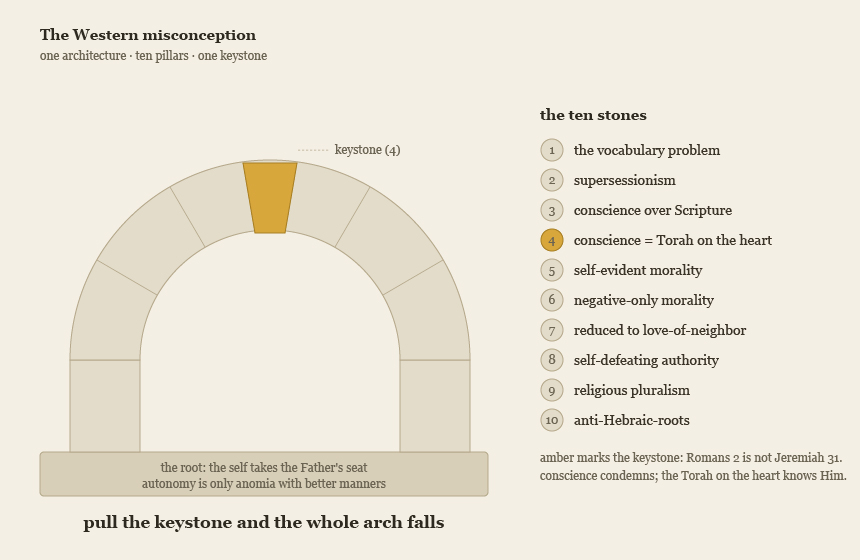
Because this response quietly puts the self in the Father's seat. It makes your conscience the source of the knowledge of God, your inner sense the authority, your own heart the standard by which even Scripture is weighed. And the moment the self is the source, you do not actually need Him to have spoken at all. You have replaced His self-disclosure with your self. Our very word for it is built from the Greek, autonomos, from autos and nomos, self and law: the self that becomes its own Torah. And that, however reverent it feels, is the respectable face of the very thing Yeshua named when He warned of anomia, a life lived without the Father's Torah. Autonomy is only anomia with better manners. It is also the oldest offer ever made to any of us, the one in the garden: you shall be as God, knowing, deciding good and evil from inside ourselves instead of receiving it from the Father (B'reshit [Genesis] 3:5).
And here is the single verse that makes the whole structure look biblical, so look at it closely. Sha'ul says the Gentiles show "the work of the law written on their hearts," their conscience also bearing witness (Romans 2:14-15). There it is, people say: the law is already on every heart, so I have it within, and I need nothing more. But read the Greek. Sha'ul wrote ergon tou nomou, the work of the law, its single ethical effect, the bare sense of right and wrong that leaves a man, in the very next breath, "without excuse." That is not the Torah written on the heart. That is the law's shadow, and its whole job in Romans is to accuse, to convict, to leave you guilty. Conscience gives you exactly enough law to be condemned by it, and not one word of the Father's face.
Now set beside it the promise these readers believe it equals. In Yirmeyahu 31 the Father says, "I will put My Torah within them and write it on their hearts," and He says it covenantally, to the house of Israel and the house of Judah, and He tells you the result: "they shall all yada me, from the least of them to the greatest." Not "they will sense that harming people is wrong." They shall know ME. The Person. The whole positive weight of who He is, the thing no conscience has ever produced on its own. One text condemns you with the negatives you already feel. The other gives you the Father you could never have guessed. To collapse them, to call conscience the Torah on the heart, is to mistake the accusation for the embrace, and then to use the accusation to argue you never needed the embrace. (The full architecture of this misconception, all of it sourced from this one move, is being mapped in the Restoration Atlas so you can see how the pillars hold each other up.)
So when the Father promises to write His Torah on your heart, He is not promising to make your conscience louder. He is promising to put inside you the one thing the conscience never held: Himself, in His own words. Which is exactly what He does next.
What the Spirit Does With the Letter
Here is where every myth runs out of road, and where the real picture finally comes into view. A letter can be guarded. A letter can be abandoned. A letter can be mistaken for the voice already in your own chest. But a letter can also be written, the true letter, the Father's own words, somewhere it can never again be lost. And that is what He intended all along.
Listen to the promise in Yirmeyahu 31 once more, now that we know what it is not. A day is coming, He says, when He will put His Torah within us and write it on our hearts. The same lev He asked us to lay His words upon, He now promises to inscribe Himself. We could not carry Him there on our own, so He says He will do the carrying. The heart that could not be forced, He wins by writing on it.
And He tells us how. In Yechezkel [Ezekiel] 36 He says, "I will put my Ruach [Spirit] within you, and cause you to walk in my chuqqim [statutes]" (Yechezkel [Ezekiel] 36:26-27). There is the hinge the whole letter has been moving toward. Understand what the Ruach is, because everything turns on it. The word means breath, wind, the moving air of life itself. It is the same Ruach that hovered over the waters in the beginning (B'reshit 1:2), the very breath HaShem breathed into the first man (B'reshit 2:7). So the Ruach HaKodesh, the Spirit of Holiness, is not some separate being standing apart from Him, and it is not your own conscience given a holier name. It is HaShem's own breath, His own presence, set down inside you. The Ruach is not an alternative to the mitzvot, and not an alternative to Him. It is how He writes the mitzvot inward, how He turns a command you obey into a love you live, how He makes the reading become a knowing. And mark this, because it is the whole difference: it is not your own heart amplified. It is His heart, given. The Torah written by the Ruach on the lev is the Father Himself teaching you to want what He wants.
Watch what that does to an ordinary commandment, because this is where it stops being abstract.
Two people keep Shabbat. One is watching the clock and counting the prohibitions, measuring the permitted distance, anxious he has missed something. He is tending a fence. The other has been drawn by the Ruach into the Father's own rest, and the day has become the weekly hour a son spends unhurried in his Father's house. Same command. Two entirely different interiors. One is managing a rule. One is keeping an appointment with Someone he loves.
Two people give tzedakah [righteous giving]. One writes the check to balance the ledger and feel the account is square. The other has had his very wants rebuilt, so that the Ruach has made him love the man he is helping, and the giving is no longer a tax on righteousness but the natural motion of a retrained heart. Same mitzvah. One is paying. One is loving.
Two people come to the moadim [appointed times], the feasts Constantine's church legislated away. One shows up because the calendar says to. The other meets the Bridegroom at the times He set for the meeting, and finds the feasts were never Israel's homework but the Father's own anniversaries, the dates He circled to be with His people. The same is true at the table, in the keeping of His ways with food, in every command you could name. Kept from the outside, it is compliance. Written on the inside by the Ruach, it is the native language of a son who has learned his Father's house.
This is not a new arrangement that cancels the old one. This is the Father keeping the Yirmeyahu promise. When the Ruach was poured out at Shavuot [the Feast of Weeks], the same feast where Israel received the Torah at Sinai, HaShem was not replacing the Torah. He was writing it where it could never again be guarded into silence, or set down as expired, or mistaken for a voice we generated ourselves. This is what Sha'ul means by the Torah of the Ruach (Romans 8:2), and by the fruit of the Ruach against which there is no law (Galatians 5:22-23). How could there be a law against it? It is the law itself, finally lived from the inside.
The Warning Underneath Both
So hear the warning to the one who guarded the letter until the Voice went quiet behind the fence. And hear it to the one who decided the letter no longer applied and therefore never read what HaShem actually said about Himself. And hear it to the one who traded the letter for the voice in his own chest and called it the Spirit. The warning sits underneath all three, because Yeshua himself spoke it, and He spoke it in the language of yada.
When He turns people away in Matthew 7, people who were certain they belonged to Him, who called Him Lord and did mighty works in His name, His words are not "you broke the rules." His words are "I never knew you. Depart from me, you workers of anomia." We have already met the word and its respectable face. Read it plainly here: built from nomos, law, with the a that negates it, it means without Torah, the life sourced from the self instead of from the Father who spoke. Sit with what Yeshua bound together in that one sentence. The charge is Torahlessness. The verdict is a failure of knowing, the very negative of yada. He does not say they failed an exam. He says there was never a relationship. They had His name in their mouths and had never met Him.
That is what a misfiled letter finally costs. Read the Torah as a law to be guarded, or a law to be escaped, or a thing you already contain, and you can spend an entire life close to it and never once yada the One who wrote it. The most painful thing a person could ever hear from the Maker of the universe is not "you failed." It is "I never knew you."
The Invitation
But hear why that warning is in the letter at all. It is not there to frighten you out. It is there to wake you to how much of Him is on offer that you were told you could not have. To the one who set the letter down, or who thought he had outgrown it: there is more of your Father available to you than the doctrines about Him, or the feelings within you, ever let you reach for. And to the one just beginning, who hears the word anomia and feels the old dread rise, that you will never keep all 613 and are therefore already disqualified, hear the order of things, because the order is the whole gospel. The Father wrote the letter first. He gave Himself before He asked for anything. The mitzvot are not an examination handed to a stranger. They are the shape of an intimacy offered before the structure existed, and the Ruach is given to do in you the writing you could never do yourself. You are not being handed a test. You are being handed a Father.
So this is the invitation to all of us. The category was wrong from the start. The Torah is not the law we were handed. It is the Father introducing Himself, and the Ruach standing ready to write Him where He can never again be lost. The letter is open. He is still speaking. Read it as a letter. Come and yada Him, so that you are never someone He has to say He never knew.
And do not take my word for any of it. Every myth left a paper trail, and so did the covenant that outlasts them all. We have laid the trail out on the wall in the Restoration Atlas, timelines that let you walk the fence, the departure, the self in the Father's seat, and the renewed covenant for yourself. The Scripture is the standard. The timelines are only the reference. Go and see whether these things are so.
Selah
Sit with these before you move on:
- Which myth have you been living inside: the one that guards the letter until the Voice goes quiet, the one that set the letter down and called the distance freedom, or the one that mistook your own heart for His?
- When you keep a command, what is actually moving you: the fear of getting it wrong, the relief of being excused from it, or a love that has come to want what the Father wants?
- If the Ruach were to write one mitzvah on your heart this week, not as a rule you perform but as a love you live, which one would you ask Him to begin with?
- Have you ever read the Torah the way you would read a letter from Someone who wanted to be known by you? And if you have not, what would it cost you to start tonight?
May the shalom of our Abba guard your study and your wrestling, shalom v'shalvah.
Your brother in the Way,
Sergio